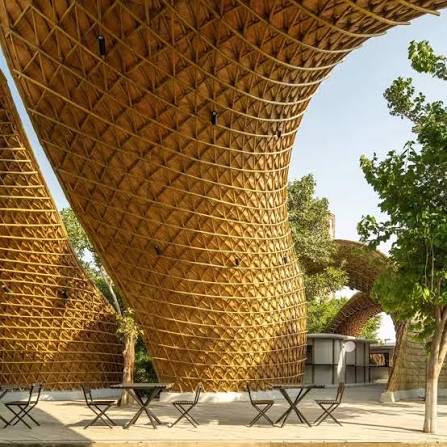
Image: The Hungry Caterpillar, Ashoka University — Lyth Design / bamboo gridshell canopy
Grown, Not Quarried: Apoorva Shroff's Bamboo Gridshell at Ashoka University
WAAR Editorial · 2 min read
The Hungry Caterpillar is essentially a new campus food street, but architect Apoorva Shroff deliberately avoided making it feel like a conventional collection of food kiosks. Occupying an underused area beneath existing trees at Ashoka University, the architecture weaves through the landscape rather than clearing it, creating a shaded, informal environment where students can eat, meet and linger.
The name comes from the idea of a caterpillar feeding beneath the protection of foliage. Shroff developed the architectural language around growth, transformation, shelter and interdependence — themes that resonate strongly within a university environment, where young people are themselves undergoing a process of transformation.
This is where the project becomes particularly interesting for WAAR. The dramatic roof is a bamboo gridshell, not simply a bamboo-clad roof. The longest shell spans approximately 19 metres and uses four layers of relatively slender bamboo members arranged diagonally at roughly 45 degrees. The geometry creates a complex double curvature, giving the canopy its folded-leaf, cocoon-like appearance.
The project also combines several low-impact technologies: bamboo gridshells as both structural and shading systems; 3D-printed concrete modular kitchen units; recycled plastic outdoor furniture; existing trees and landscape integrated rather than displaced; and passive shading that filters sunlight to create cooler outdoor spaces.
The structural engineering was undertaken by Atelier One in London, architectural detailing by Jurian Sustainability, and bamboo construction by Jans Bamboo. The design team included Khushi Saraiya and Param Gala.
This is exactly the kind of project WAAR should be featuring. It is not just a beautiful bamboo structure; it represents a convergence of traditional material, advanced engineering, digital fabrication, sustainable construction and biophilic design. There is also a compelling human story: Apoorva Shroff travelled to Bali in 2023 to study bamboo construction, subsequently bringing that knowledge into this project at Ashoka University.
For WAAR's readers, the broader lesson is that small-scale, low-carbon interventions can carry the same intellectual ambition as larger commercial buildings. The Hungry Caterpillar shows how a modest campus food hub can become a built argument for craft, research and place-making.