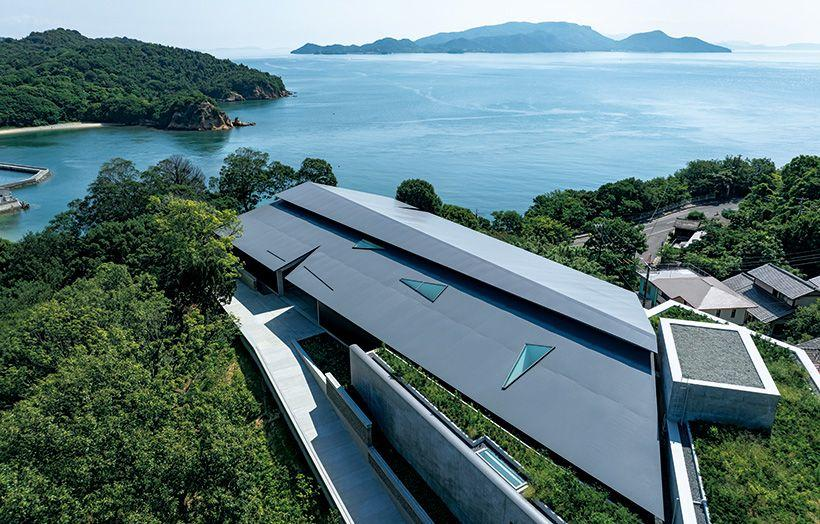
Seen from above, the museum's low pitched roof settles into the hillside above the Seto Inland Sea — a building that belongs to its landscape before it announces itself. Photo: Benesse Art Site Naoshima.
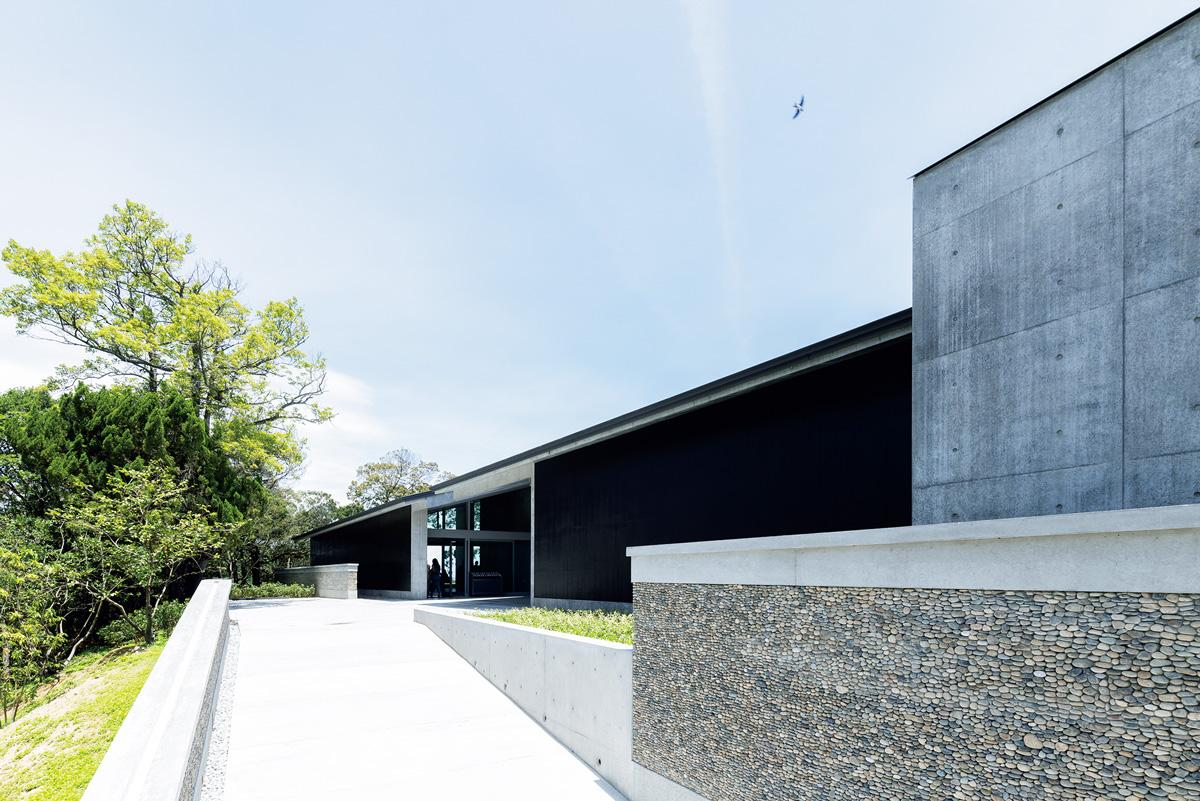
The approach to the museum: dark exterior finishes and textured stone walls echo the material language of Honmura village. Photo: Benesse Art Site Naoshima.
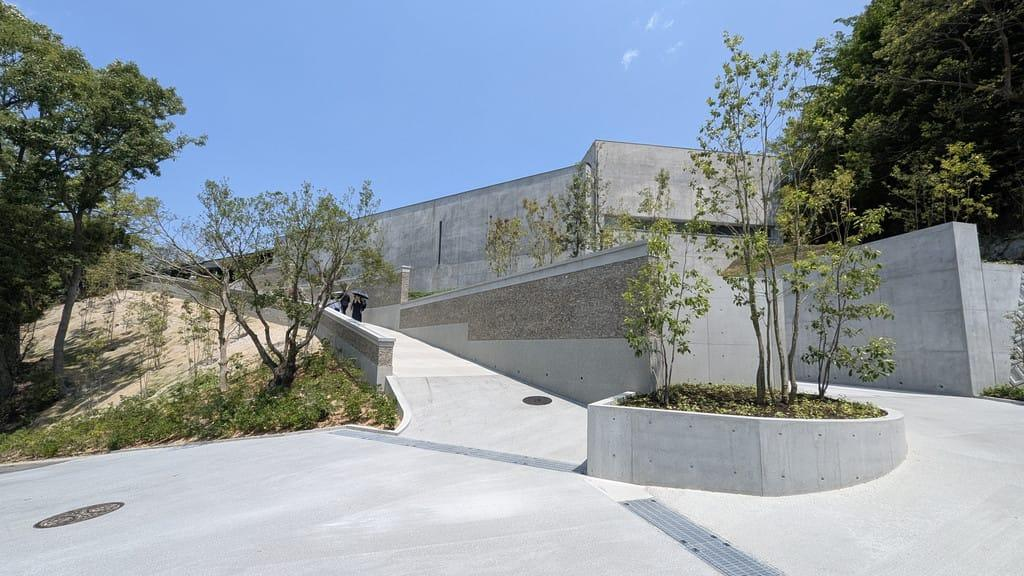
Concrete, planting and topography shape the forecourt — the transition between the ordinary world of the village and the concentrated experience of art. Photo: Benesse Art Site Naoshima.
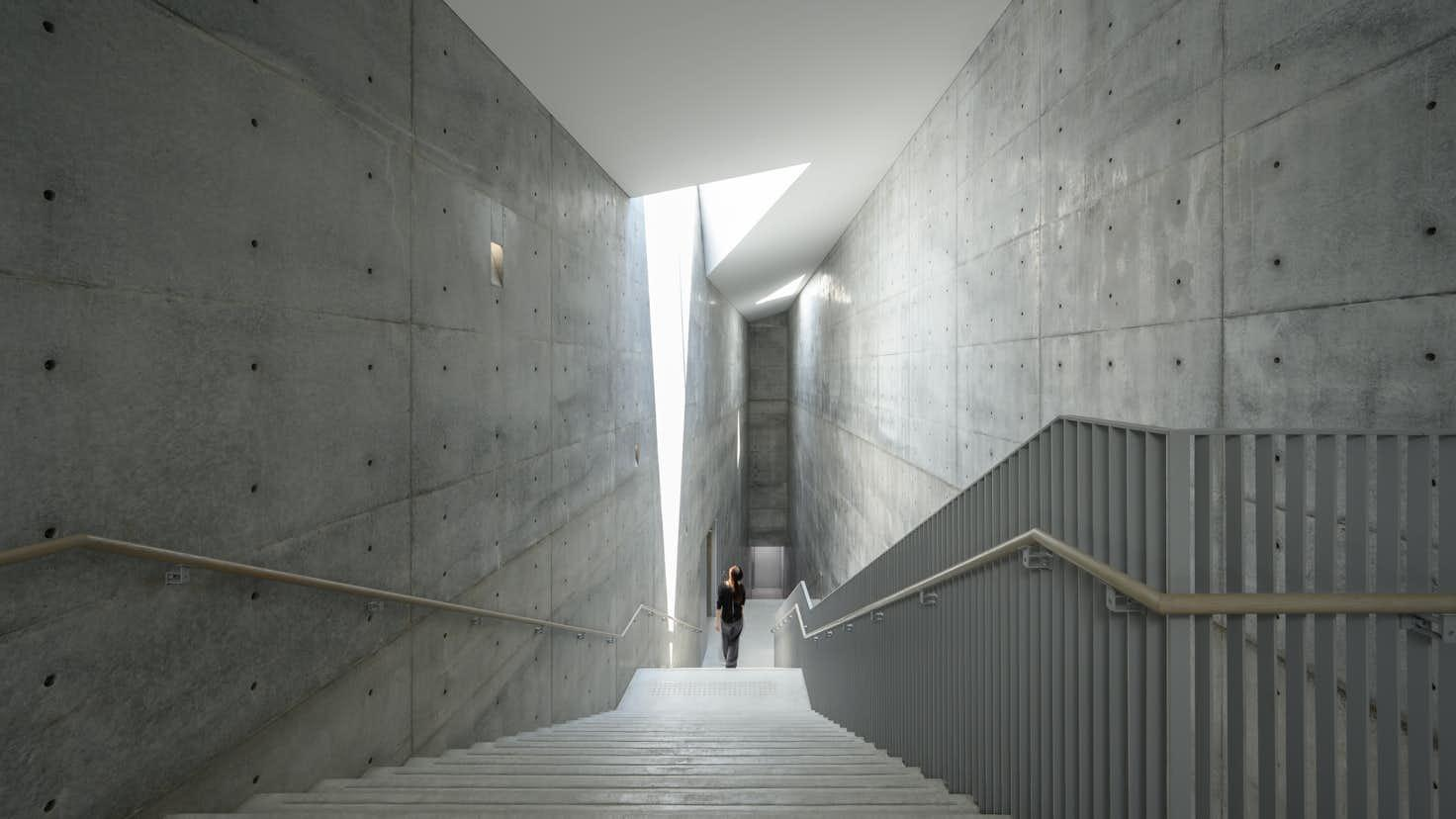
The central staircase descends through two underground levels, lit from a skylight above — concrete made an instrument of atmosphere. Photo: Benesse Art Site Naoshima.
Naoshima New Museum of Art: Tadao Ando's Quiet Monument to the Future of Asian Art
WAAR Editorial · 9 min read
Some buildings announce themselves through spectacle. Others invite us to slow down, observe and discover their meaning gradually.
The Naoshima New Museum of Art belongs to the latter tradition. Designed by the celebrated Japanese architect Tadao Ando and opened on 31 May 2025, the museum occupies a hillside near the Honmura district of Naoshima, an island that has become an internationally recognised destination for art and architecture. It is the tenth architectural project Ando has contributed to the Benesse Art Site Naoshima initiative — and the first to carry the island's name.
Yet this is not simply another addition to an already remarkable architectural landscape. The museum signals an expanded ambition: to create a lasting home for contemporary art from Japan and across Asia, while deepening the relationship between cultural institutions, local communities and the places they inhabit.
In Ando's hands, architecture becomes more than a container for art. It becomes a way of preparing the visitor to encounter it.
01. An Architecture That Belongs to Its Place
The first impression is one of restraint. Rather than competing with the landscape through monumental height or an expressive silhouette, the museum sits close to the ground. Its low profile and pitched roof acknowledge the architectural character of the surrounding village, while dark exterior finishes and textured stone walls connect the building to Naoshima's traditional material language.
This is an important distinction in Ando's approach. Contextual architecture does not necessarily mean reproducing the past. It can mean understanding the proportions, textures and atmosphere of a place, then translating those qualities into a contemporary architectural vocabulary. The museum is recognisably modern, yet it avoids the visual isolation that can occur when cultural buildings are conceived as objects entirely separate from their surroundings.
Its presence is quieter, more deliberate. The architecture establishes a relationship with the village before the visitor even enters the galleries. For WAAR, this is where the project becomes especially compelling: the building demonstrates that architectural distinction does not always require visual dominance. Sometimes, the most sophisticated response is to create a structure that belongs to its setting while retaining a clear identity of its own.
02. The Poetry of Concrete, Light and Space
Few contemporary architects have developed a more recognisable relationship with material and light than Tadao Ando. His work often draws its power from the controlled interaction of concrete, geometry, natural illumination and the movement of the human body through space.
At Naoshima, that architectural language is adapted to a museum with much of its volume concealed beneath the hillside. The building comprises one level above ground and two below, allowing the visible structure to remain relatively modest while accommodating substantial exhibition space. A carefully positioned skylight brings natural light into the interior, and a central staircase connects the museum's levels.
The descent into the building becomes part of the experience. The visitor moves away from the ordinary scale of the village and enters a sequence of spaces in which light, proportion and material help shape attention. Concrete, often associated with weight and permanence, becomes an instrument of atmosphere. Light softens its severity, while the changing relationship between open and enclosed spaces introduces rhythm.
The architecture does not need to overwhelm the artworks. It establishes conditions in which visitors can look more carefully, move more slowly and become more conscious of their surroundings. This is one of Ando's enduring strengths: his buildings are not simply seen; they are experienced through time, movement and perception.
03. A Museum for Asia's Contemporary Voices
The museum's architectural identity is inseparable from its cultural purpose. The Benesse Art Site Naoshima initiative has developed over several decades into a network of museums, installations and cultural spaces across Naoshima and neighbouring islands. The new museum expands that network with a particular emphasis on contemporary art from Japan and the wider Asian region.
Its inaugural exhibition, From the Origin to the Future, opened with works by twelve artists and groups from across Asia, bringing together established figures and new site-specific creations. Among the artists represented were Takashi Murakami, Do Ho Suh and Cai Guo-Qiang.
The significance of this focus extends beyond the addition of another exhibition venue. Asia is not a single artistic tradition. It is a vast and diverse constellation of histories, languages, religions, political experiences, material cultures and contemporary realities. A museum committed to presenting art from across the region has the opportunity to reveal connections without erasing differences.
Such a programme can challenge the assumption that global contemporary art must be understood primarily through institutions and narratives centred in Europe and North America. Instead, the museum creates room for Asian artists to be encountered in a setting that recognises the region as a source of ideas, experimentation and cultural futures. The ambition is not simply to bring more art to Naoshima. It is to broaden the perspectives through which visitors understand the world.
04. Architecture as a Framework for Encounter
A museum is often judged by its collection, but its influence also depends on the encounters it makes possible. Naoshima New Museum of Art is intended to be a place for changing exhibitions, talks, workshops and other public programmes. Its role is therefore not limited to displaying completed works; it is also to encourage exchange among artists, residents and visitors.
This ambition is especially relevant to its position within the Honmura area. Unlike a cultural destination separated from everyday life, the museum sits within a village environment. Its relationship with the community is part of its stated purpose. The café and outdoor terrace extend the visitor experience beyond the galleries, offering opportunities to pause and take in the surrounding landscape, while the building's architectural sequence provides a transition between the ordinary world outside and the concentrated experience of looking at art.
These elements suggest a broader understanding of the museum as civic infrastructure. It is a place to encounter art, but also a setting in which people can meet, discuss, learn and develop new perspectives. For cultural architecture, this is a valuable model. The strongest institutions are not necessarily those that feel most monumental. They are those that can remain relevant to their communities while attracting an international audience.
05. Naoshima and the Long View of Cultural Investment
Naoshima's transformation into an international art destination did not happen overnight. The Benesse Art Site began developing its cultural vision in the late 1980s, gradually establishing museums, artworks and other facilities across the islands. The new museum is part of this longer commitment to linking art, architecture, nature and community.
This long horizon offers a lesson for developers, investors and public authorities. Cultural infrastructure can create value that is difficult to measure through conventional property metrics alone. A museum may generate tourism and local economic activity, but it can also build a place's identity, support education, attract creative practitioners and establish a reputation that develops over generations.
These benefits depend on more than the building itself. They require sustained programming, thoughtful management, community participation and a willingness to invest beyond the initial construction phase. Naoshima illustrates how a consistent cultural vision can gradually alter the way a place is perceived internationally. The island's identity is now closely connected with its artistic and architectural experiences, rather than being defined solely by its geography.
The new museum strengthens that identity while introducing a wider emphasis on contemporary Asian art. For emerging cultural destinations elsewhere in the world, the lesson is not to copy Naoshima's buildings. It is to recognise that meaningful cultural districts are built through continuity, collaboration and a clear sense of purpose.
06. The Sustainability of Building with Restraint
The museum's integration with the hillside offers an architectural argument for restraint. By placing two levels below ground and keeping the visible building relatively low, Ando reduces the structure's visual prominence within the surrounding landscape.
This is a form of contextual sensitivity, though it should not automatically be equated with proven environmental performance. Assessing sustainability comprehensively would require information about embodied carbon, construction methods, energy use, cooling, material sourcing and long-term operations.
Even so, the design raises an important question for contemporary cultural architecture: how can a major institution create meaningful space without overwhelming its setting? The answer may involve more than low heights or subterranean galleries. It requires a considered relationship between building, terrain, climate, materials and the existing community.
A museum can be architecturally ambitious without becoming visually aggressive. It can make a lasting statement through proportion, atmosphere and the quality of its spaces rather than through sheer scale. In a period when cultural landmarks are frequently expected to become instant icons, Naoshima offers a quieter proposition: that architecture can earn significance through the depth of the experience it creates.
07. A Legacy Designed for Future Generations
Ando has spoken about the importance of creating experiences that remain in people's memories, particularly those of young visitors. That aspiration is consistent with a museum conceived not simply as a finished building, but as a long-term cultural institution.
Architecture has a particular capacity to influence memory. A shaft of daylight, the texture of a wall, the scale of a staircase or the sudden appearance of an artwork can become part of how a person remembers a place. When these experiences are connected to art, they can deepen curiosity and encourage visitors to return with different questions and perspectives.
This is the value of designing for more than the opening day. The building establishes a framework, but its meaning will continue to evolve through new exhibitions, changing artistic practices and the people who use it. The museum's long-term success will therefore depend not only on Ando's architecture, but on the institution's ability to remain intellectually open, locally connected and responsive to contemporary artistic life. Its true legacy will be measured by what happens inside its walls over time.
WAAR Verdict: The Power of a Quiet Cultural Landmark
Naoshima New Museum of Art brings together three powerful ideas: architecture that respects its setting, a cultural programme that expands the visibility of Asian contemporary art, and a long-term vision for the relationship between a place and its creative life.
Tadao Ando's building does not rely on overwhelming scale. Its low profile, dark exterior, concrete interiors and carefully introduced natural light create an experience rooted in material, movement and atmosphere. Yet the museum's importance reaches beyond architectural form. It adds a new dimension to Naoshima's cultural network and gives contemporary Asian art a dedicated institutional platform within one of Japan's most distinctive art destinations.
For architects, it is a study in restraint and contextual design. For cultural institutions, it is a reminder that buildings can shape how art is encountered. For developers and city-makers, it demonstrates the enduring value of a cultural vision sustained over decades rather than measured solely by immediate returns.
Ultimately, Naoshima New Museum of Art suggests that a landmark does not need to dominate its landscape to transform its meaning. Sometimes, the most powerful architecture is the architecture that creates space — for art, for reflection, for community and for perspectives that have yet to be discovered. In a world increasingly defined by visual noise, Ando's quiet monument makes a compelling case for the enduring power of thoughtful design.
Project: Naoshima New Museum of Art · Location: Honmura, Naoshima, Kagawa Prefecture, Japan · Opened: 31 May 2025 · Architect: Tadao Ando · Director: Miki Akiko · Building area: approx. 3,176 m² · Configuration: three levels — one above ground, two below · Client / operator: Fukutake Foundation, within the Benesse Art Site Naoshima initiative.