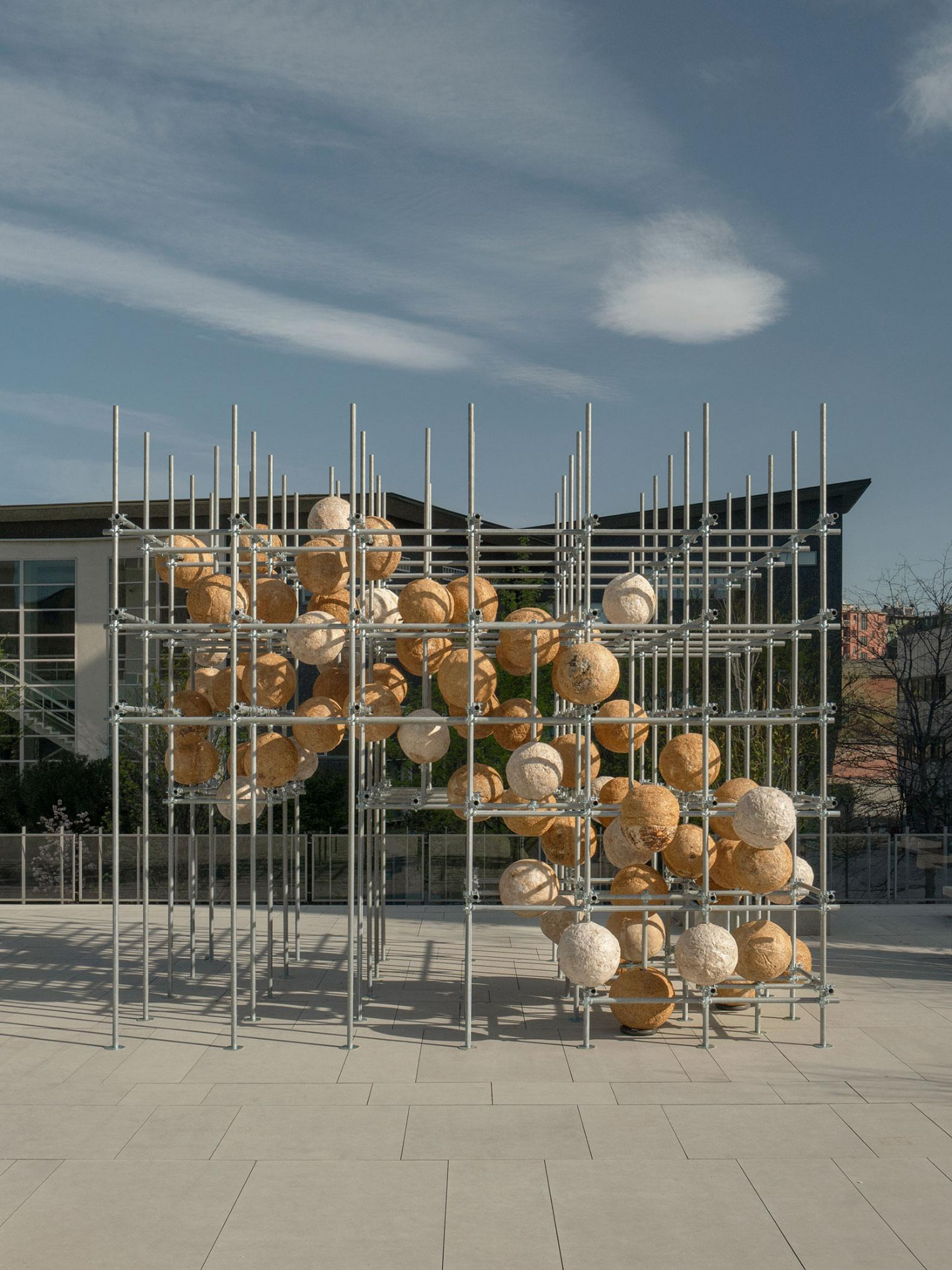
Image: Growing Matter(s), a scaffold pavilion populated by cultivated mycelium spheres — supplied to WAAR
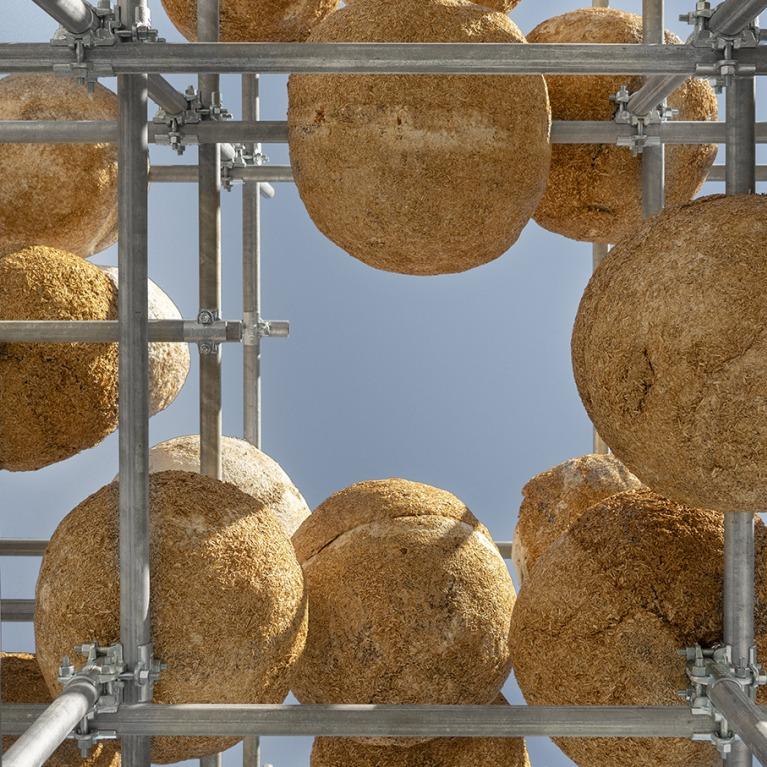
Image: The varied surfaces of the installation record the biological growth process — supplied to WAAR
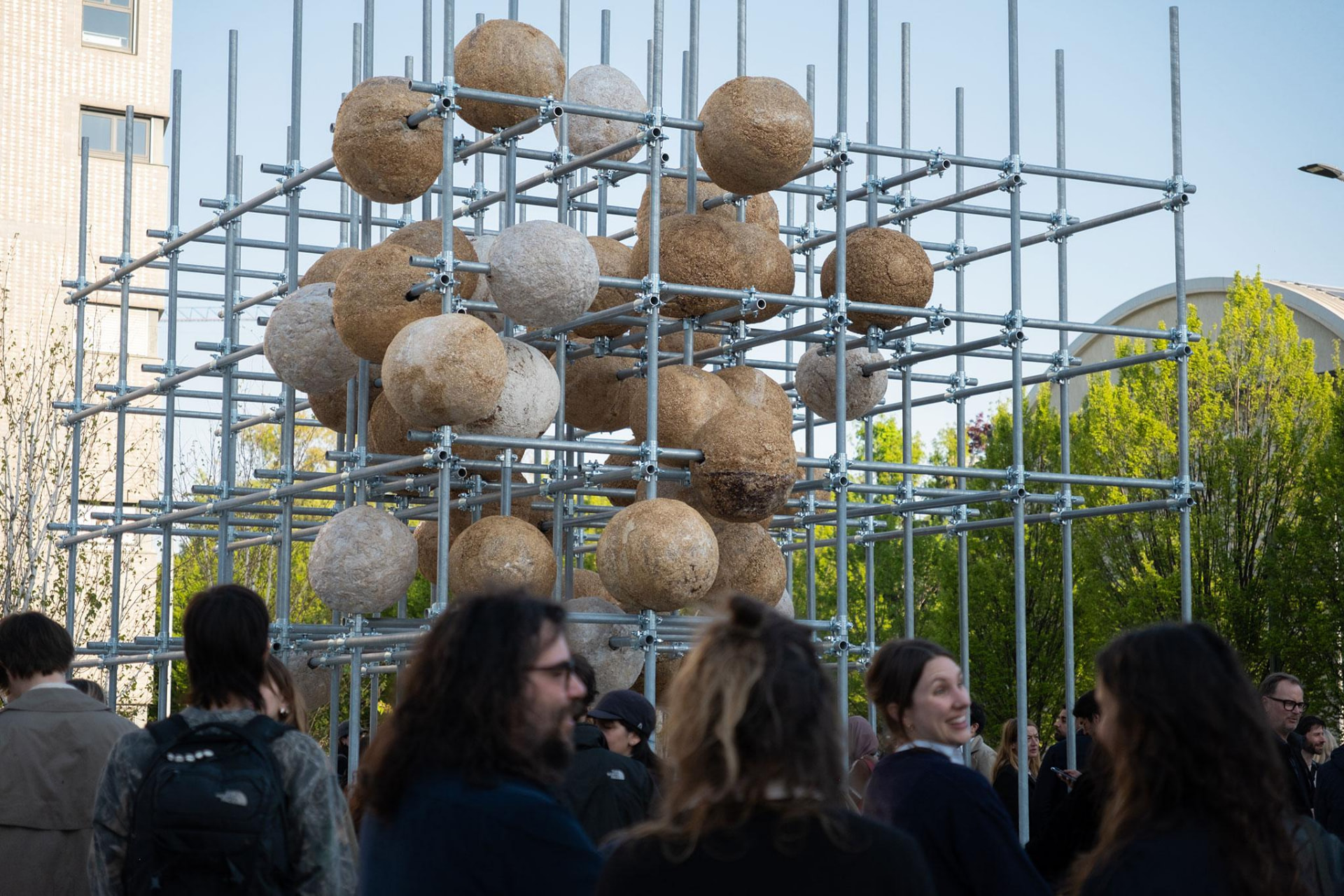
Image: Visitors gather around the modular installation during Milan Design Week — supplied to WAAR
Growing Matter(s): When Architecture Begins to Grow
WAAR Editorial · 2 min read
Architecture has traditionally been an exercise in control. Concrete is poured into precise forms, steel is fabricated to exact dimensions and glass is manufactured for consistency.
Growing Matter(s), presented by Henning Larsen with Politecnico di Milano at Milan Design Week 2025, proposes a radically different approach: what if the material itself could participate in the design? Rather than concealing the unpredictability of biological growth, the pavilion makes it the centre of its architectural expression.
80 SPHERES, 80 EXPRESSIONS OF GROWTH
At the heart of the installation are 80 mycelium spheres suspended within a modular scaffolding structure. No two are exactly alike. Some are smooth and compact; others are porous, cracked or irregular. Their differences are not defects to correct, but evidence of the process that formed them.
Mycelium responds to conditions such as humidity and airflow, meaning that appearance is influenced by the environment in which it grows. The pavilion is therefore not simply made. It is partly cultivated, and imperfection becomes an architectural quality.
GROWING ARCHITECTURE FROM WASTE
The spheres were cultivated using a substrate incorporating hemp, flour, sugar and experimental beer dregs, demonstrating how organic by-products might enter a new material economy. The mixture was inoculated with Pleurotus eryngii and Pleurotus ostreatus, formed around wooden spheres and incubated until the mycelium bound the substrate together.
Some spheres were dried to stabilise their form; others were deliberately left active. The result sits between object, organism and experiment — an installation whose material history remains visible on its surface.
A NEW DEFINITION OF BEAUTY
For centuries, architects have worked to eliminate irregularity. Growing Matter(s) asks whether variation might instead be worth celebrating. Differences in texture, colour and form reveal how each sphere developed, turning growth into a record rather than a flaw.
The project also proposes a different relationship between architecture and time. A conventional building is expected to remain stable. A living material can change. The question is no longer only how to make a form, but how to design when the material refuses to remain static.
CIRCULARITY BUILT INTO THE MATERIAL
The environmental ambition extends beyond substituting one product for another. The mycelium elements are biodegradable, while the borrowed scaffolding was designed for disassembly and reuse after the exhibition. Origin, lifespan and return to natural systems become part of the design brief.
ARCHITECTURE AFTER CONTROL
Growing Matter(s) is more than a pavilion about fungi. It is an investigation into what architecture might become when designers move from manufacturing materials to cultivating them.
Mycelium will not replace concrete, steel or glass overnight. Structural performance, durability, regulation and scale remain significant questions. But experiments like this expand the architectural imagination by treating materials not as inert products, but as participants in an ecological system.
The pavilion leaves a compelling possibility: perhaps tomorrow’s architecture will be defined not only by what humans can manufacture, but by what designers can help to grow.