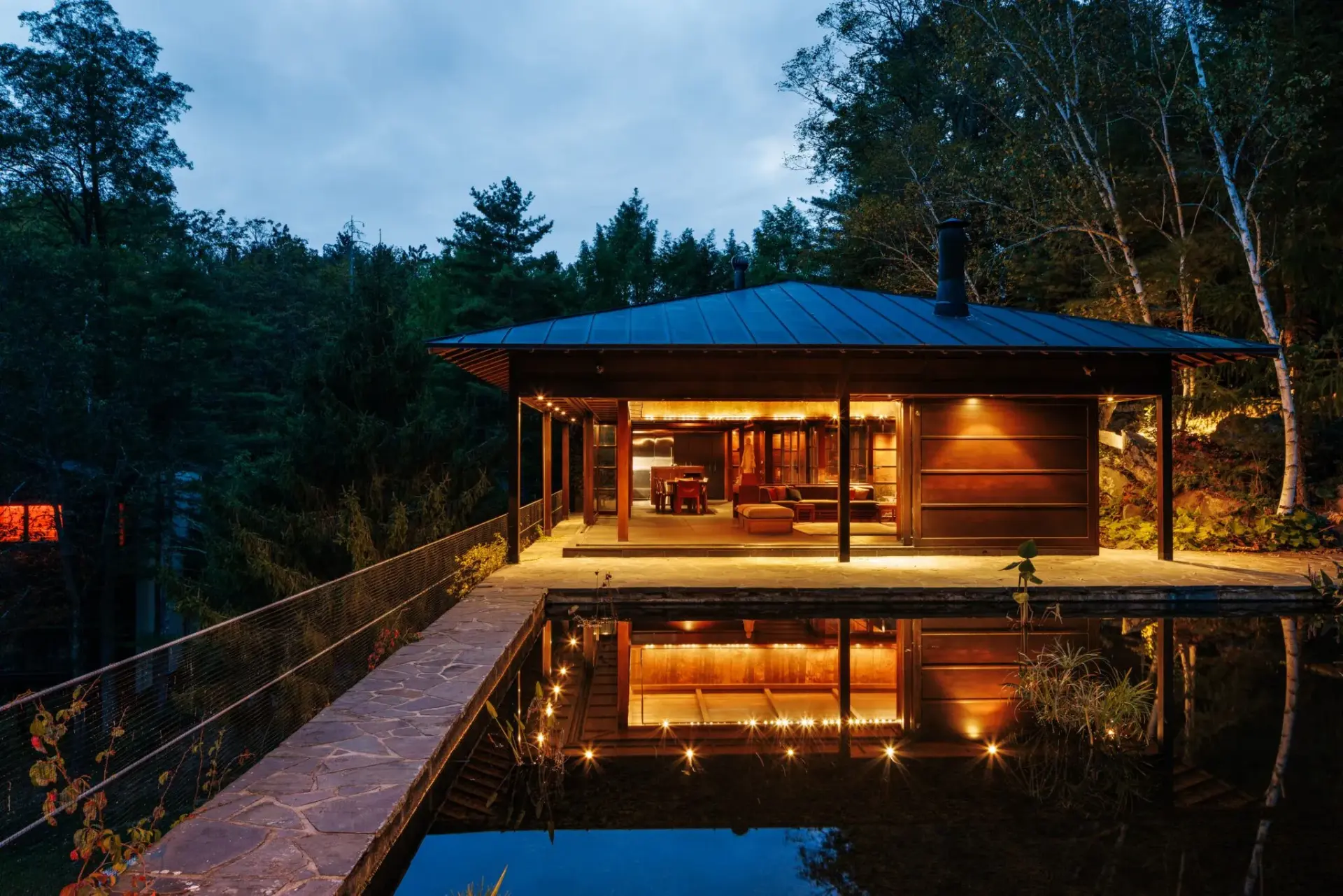
Copper roofs, timber and still water: the main pavilion opens fully to its reflecting pool at dusk. Image courtesy of Upstate Down.
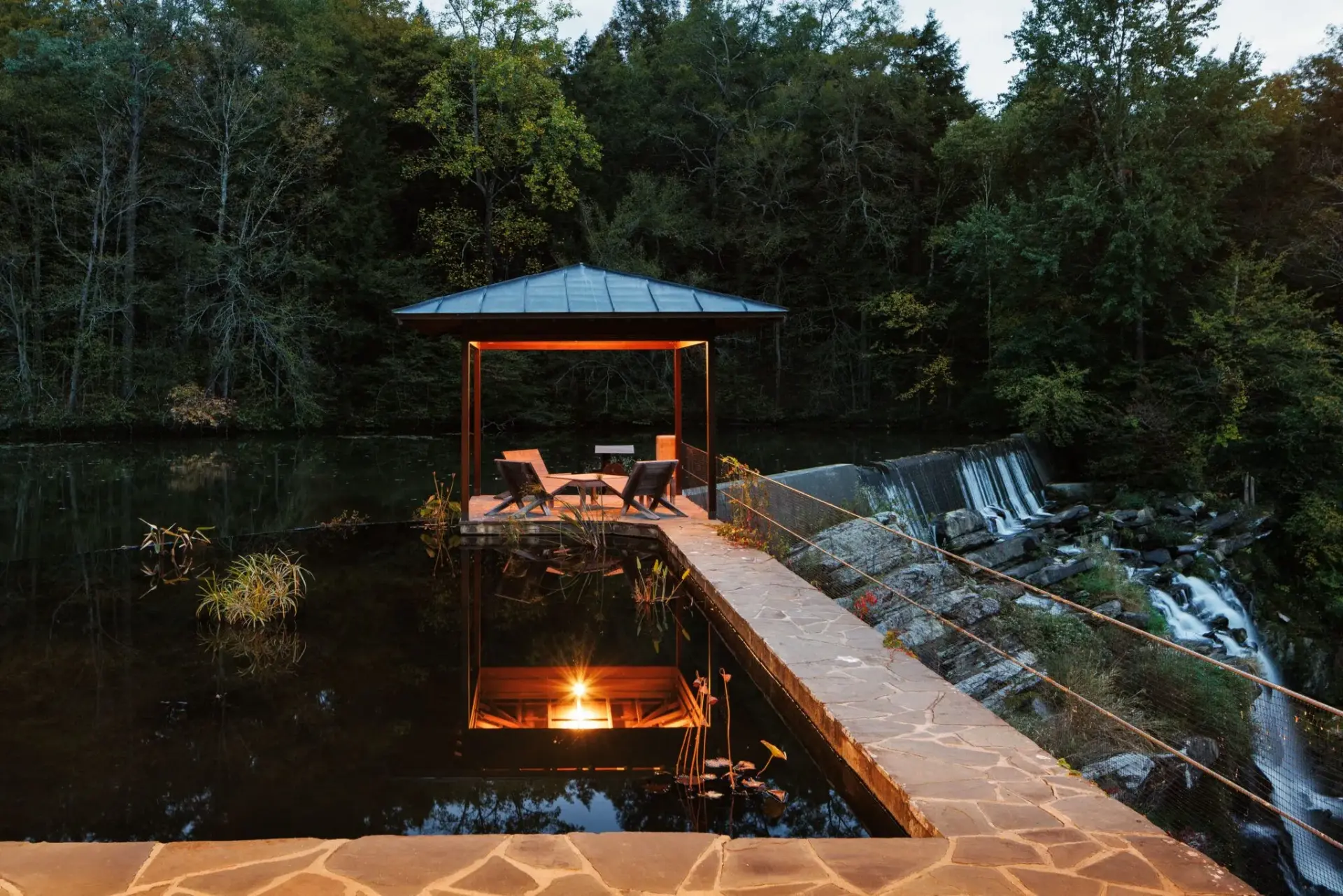
A pavilion set above the Landsman Kill, where the estate meets the 60-foot plunge it was designed around. Image courtesy of Upstate Down.
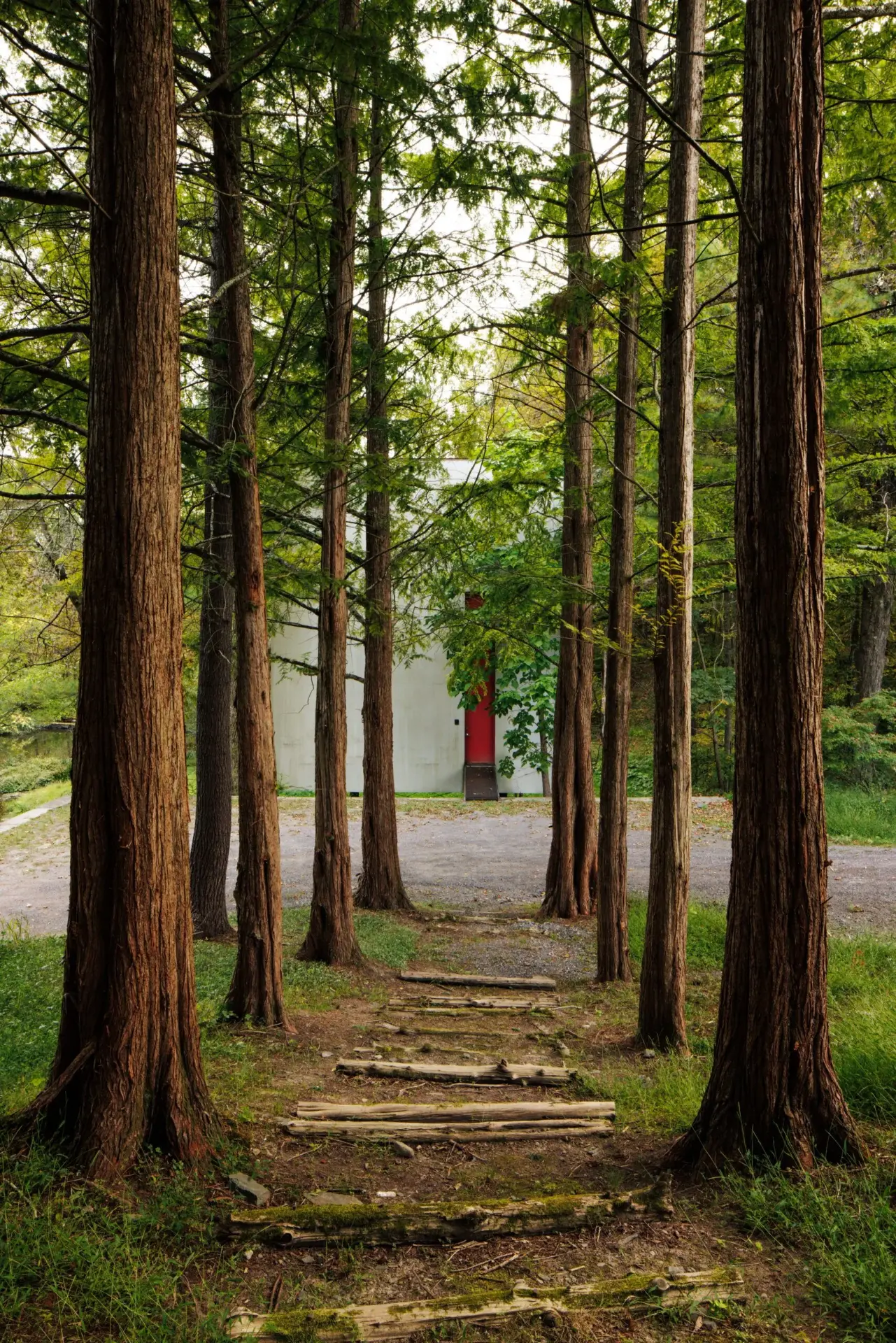
Stone paths and a grove of tall trees lead between buildings — arrival treated as a slow, deliberate passage. Image courtesy of Upstate Down.
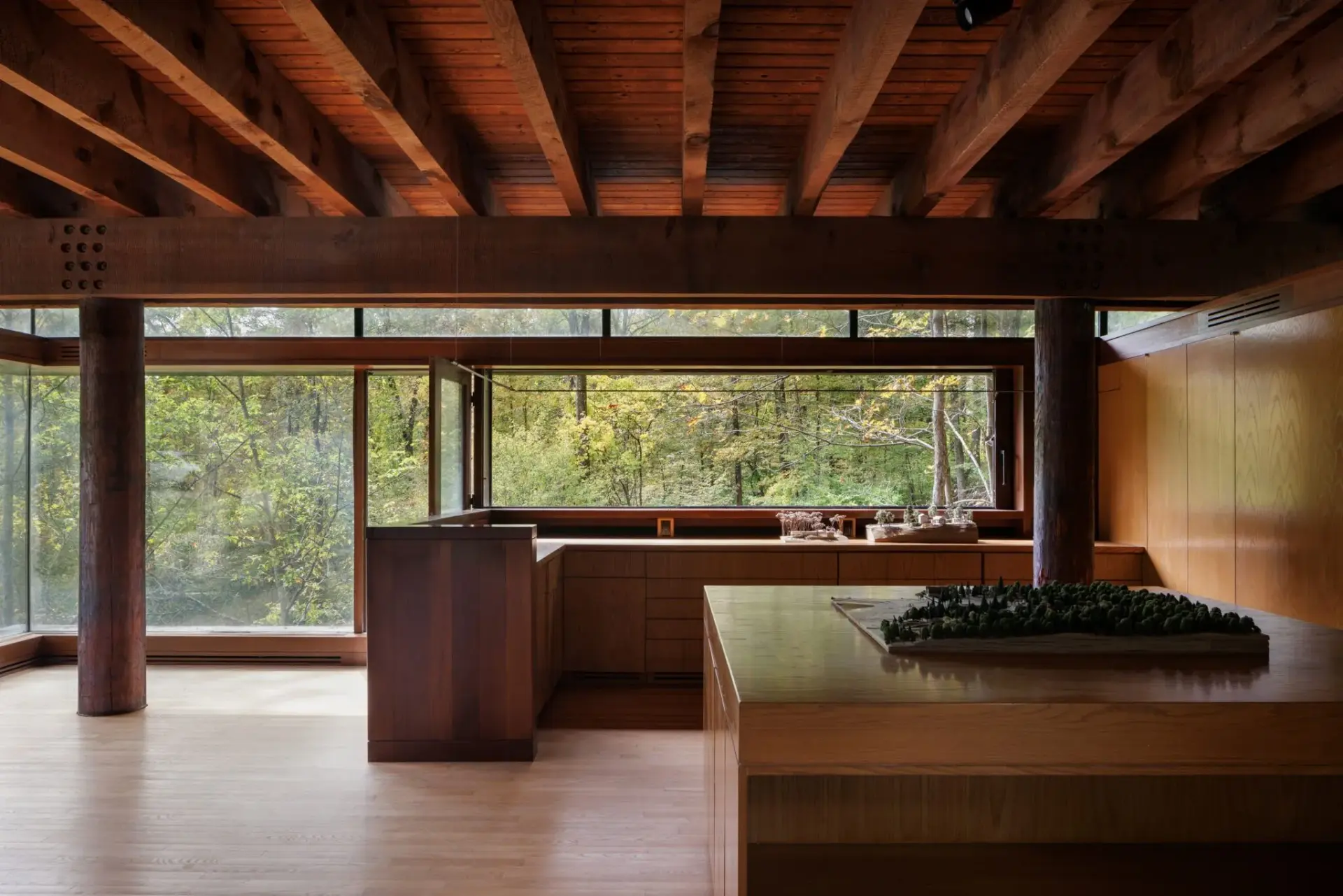
Inside, heavy timber beams and long ribbon windows frame the forest as part of the architecture. Image courtesy of Upstate Down.
The Waterfall House: Steve Mensch's Rhinebeck Retreat Returns to the Market
WAAR Editorial · 3 min read
Some houses are designed for a site. A rare few are designed around a single natural event. In Rhinebeck, New York, that event is a waterfall — a spectacular 60-foot plunge on the Landsman Kill — and the house built beside it was the late architect Steve Mensch's own primary residence.
Real estate brokerage and design firm Upstate Down has now listed The Waterfall House at $8,495,000. The 21-acre estate comprises four copper-roofed buildings — a main house, two guest houses and a studio — linked by covered walkways and stone paths.
AN ARCHITECTURE OF PAVILIONS
Rather than a single dominant volume, Mensch composed the estate as a sequence of pavilions in the landscape. The approach draws on Japanese and Balinese traditions, in which buildings are distributed across a site and the journey between them becomes part of daily life: a covered walkway, a stone path, a pause beside water.
The result is architecture that complements the waterfall rather than competing with it. Broad copper roofs sit low over timber structures; deep overhangs and fully opening walls dissolve the line between room and terrace; reflecting pools double the light at dusk. Inside, exposed beams and long horizontal windows turn the surrounding forest into the principal finish.
It is the kind of house that rewards slowness — a quality increasingly prized in the luxury market, where buyers look less for spectacle than for a genuine sense of place.
A TWENTY-YEAR RELATIONSHIP
The listing is also the closing chapter of a personal story. Twenty years ago, when Mensch was moving out of the house and renting it through VRBO, Delyse Berry — who would go on to found Upstate Down — approached him. She did not yet hold a real estate licence; she was managing exceptional home rentals, and she persuaded Mensch to let her manage his.
Within a few months, Mensch withdrew the house from its listing with Sotheby's and entrusted it to Berry, then a newly licensed agent with Houlihan Lawrence. She found renters, and the property remained rented for years — effectively taking it off the market until now.
Berry credits that relationship with shaping how she approaches real estate and, ultimately, the creation of the Upstate Down brand: a practice that treats architecturally significant homes as works to be understood and represented with care, not simply inventory to be sold. Bringing The Waterfall House to market herself is, in every sense, a full-circle moment.
A HOUSE WITH A PUBLIC LIFE
The estate is already familiar to many viewers. It appeared in Amy Schumer's docu-series Expecting Amy, filmed while she was living there, and over the years it has served as a temporary residence for a number of well-known guests — a testament to its appeal as a private retreat within easy reach of New York City.
WHY IT MATTERS
For WAAR, The Waterfall House illustrates a principle that runs through the most enduring residential architecture: value that comes from the relationship between building and landscape. Architect-designed homes of this calibre rarely change hands, and when they do, their provenance — who designed them, who lived in them, and who cared for them — becomes part of what is being acquired.
Property: The Waterfall House · Location: Rhinebeck, New York, USA · Architect: Steve Mensch (primary residence) · Site: 21 acres on the Landsman Kill, beside a 60-foot waterfall · Buildings: main house, two guest houses and a studio, with copper roofs, linked by covered walkways and stone paths · Listing: Upstate Down · Asking price: $8,495,000.