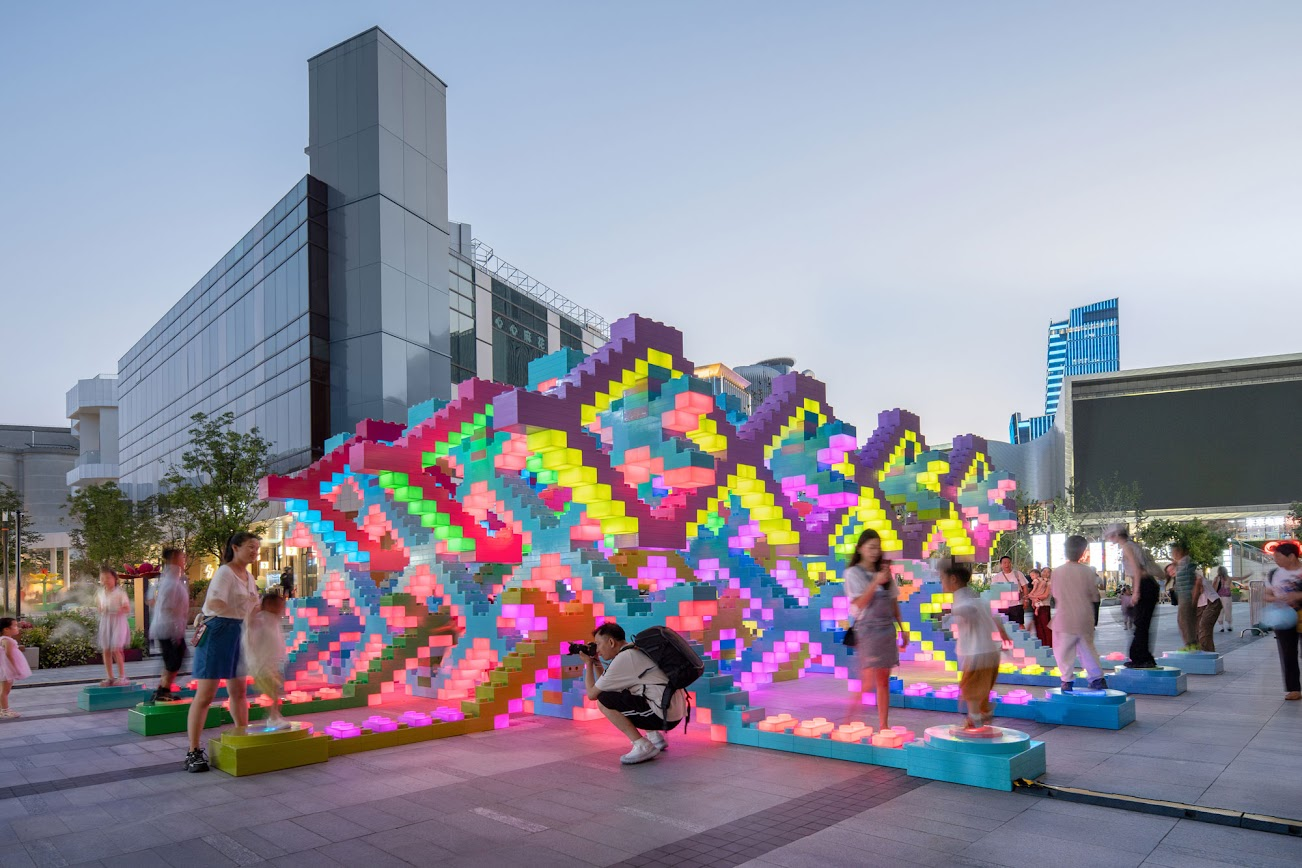
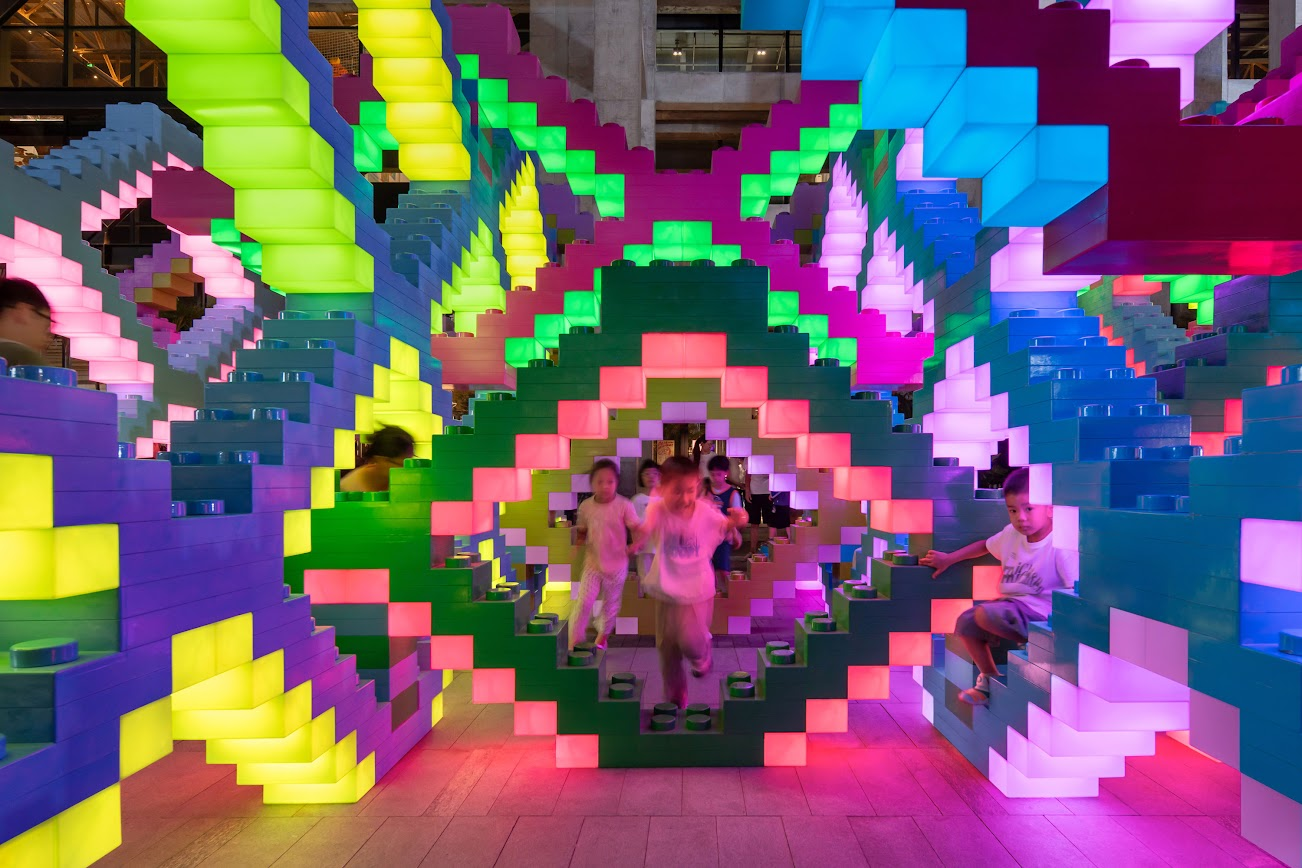
The Lightweaving Playground at Gate M, West Bund Dream Center, Shanghai · Visitors activate the woven modular installation at dusk. Photography: ZHANG Chao, TIAN Fangfang.
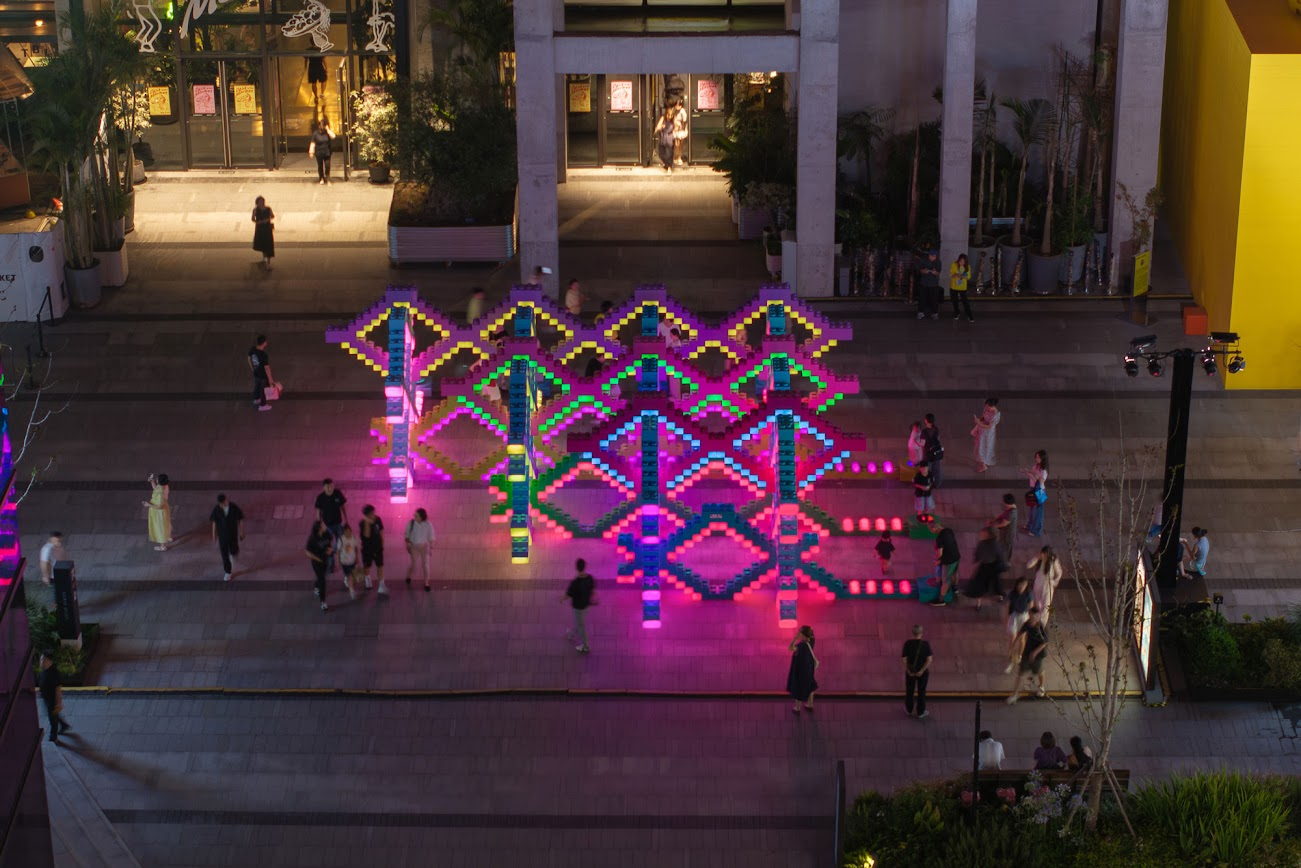
An aerial view after dark reveals the glowing geometry of the 126.36-square-metre installation as colour ripples across the plaza. Photography: ZHANG Chao, TIAN Fangfang.
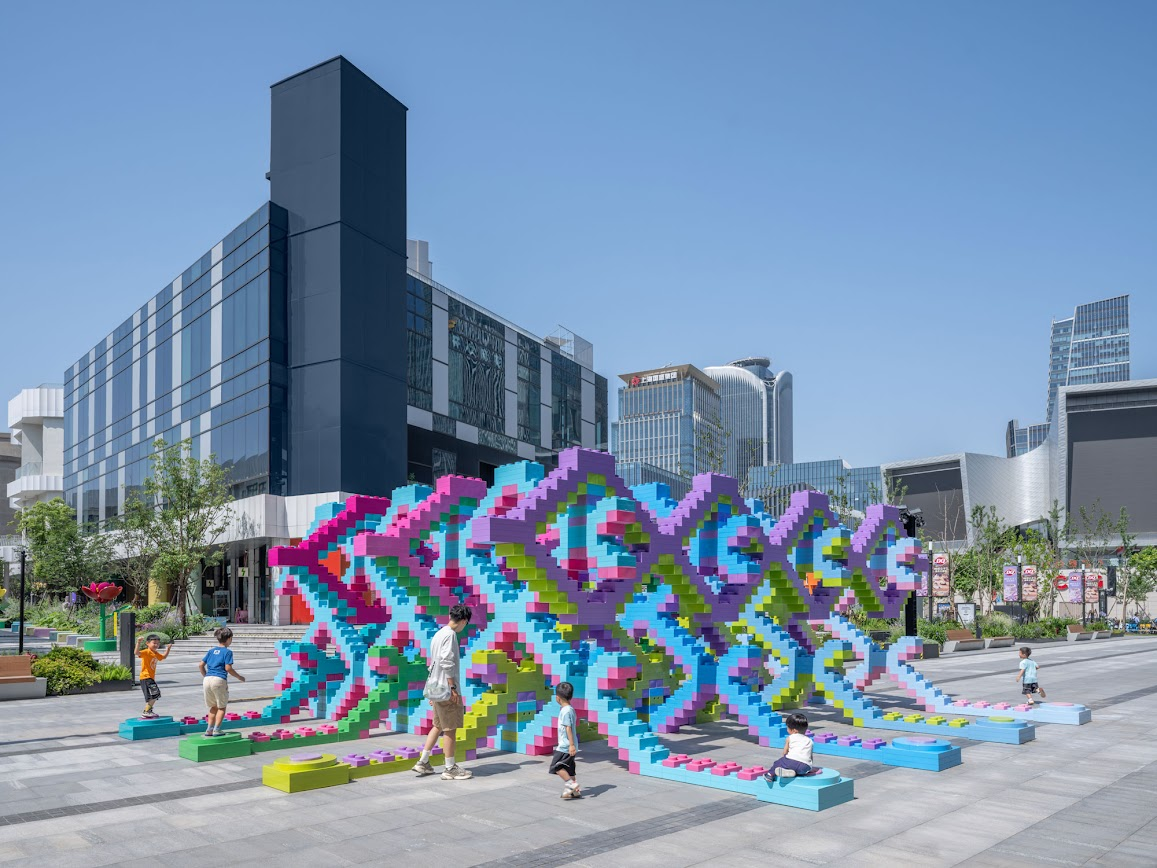
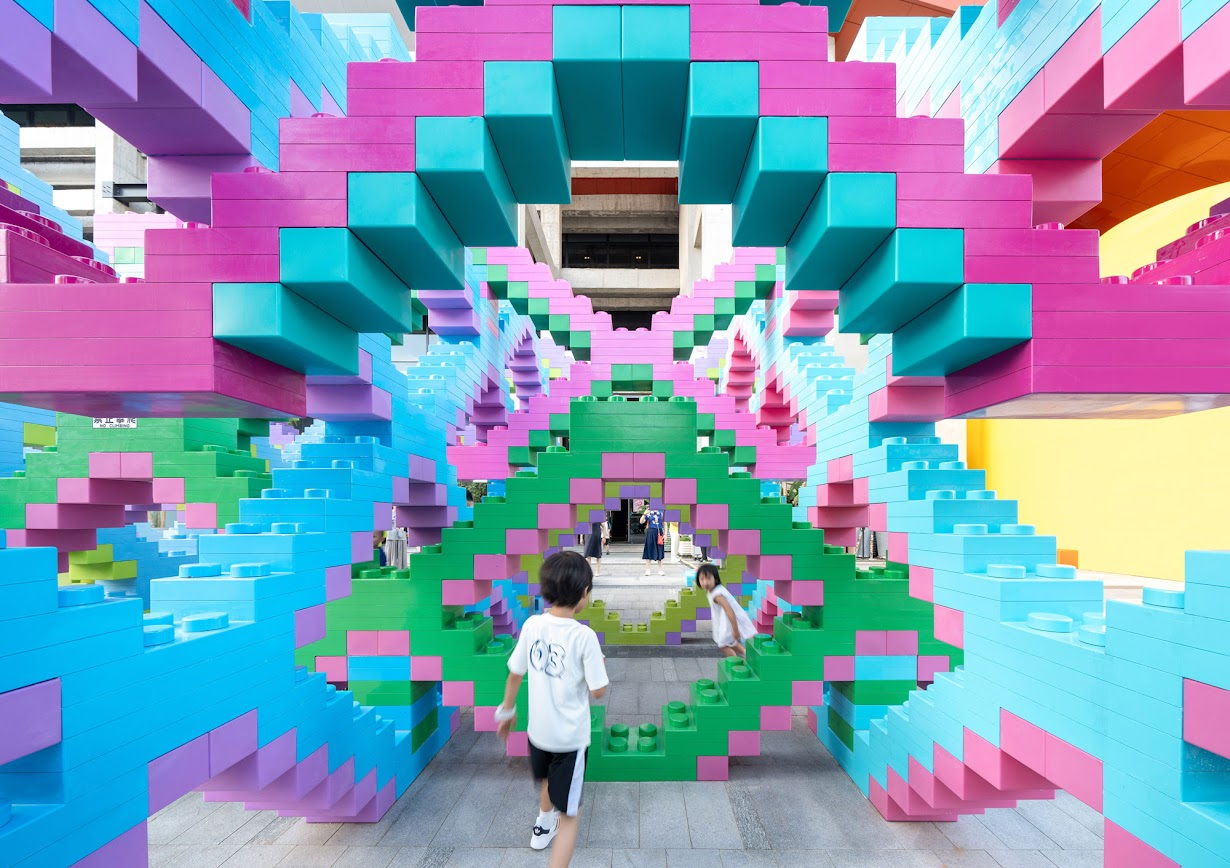
By day, the porous woven structure invites children and adults to gather, step onto the interactive jumping buttons and move freely through the plaza. Photography: ZHANG Chao, TIAN Fangfang.
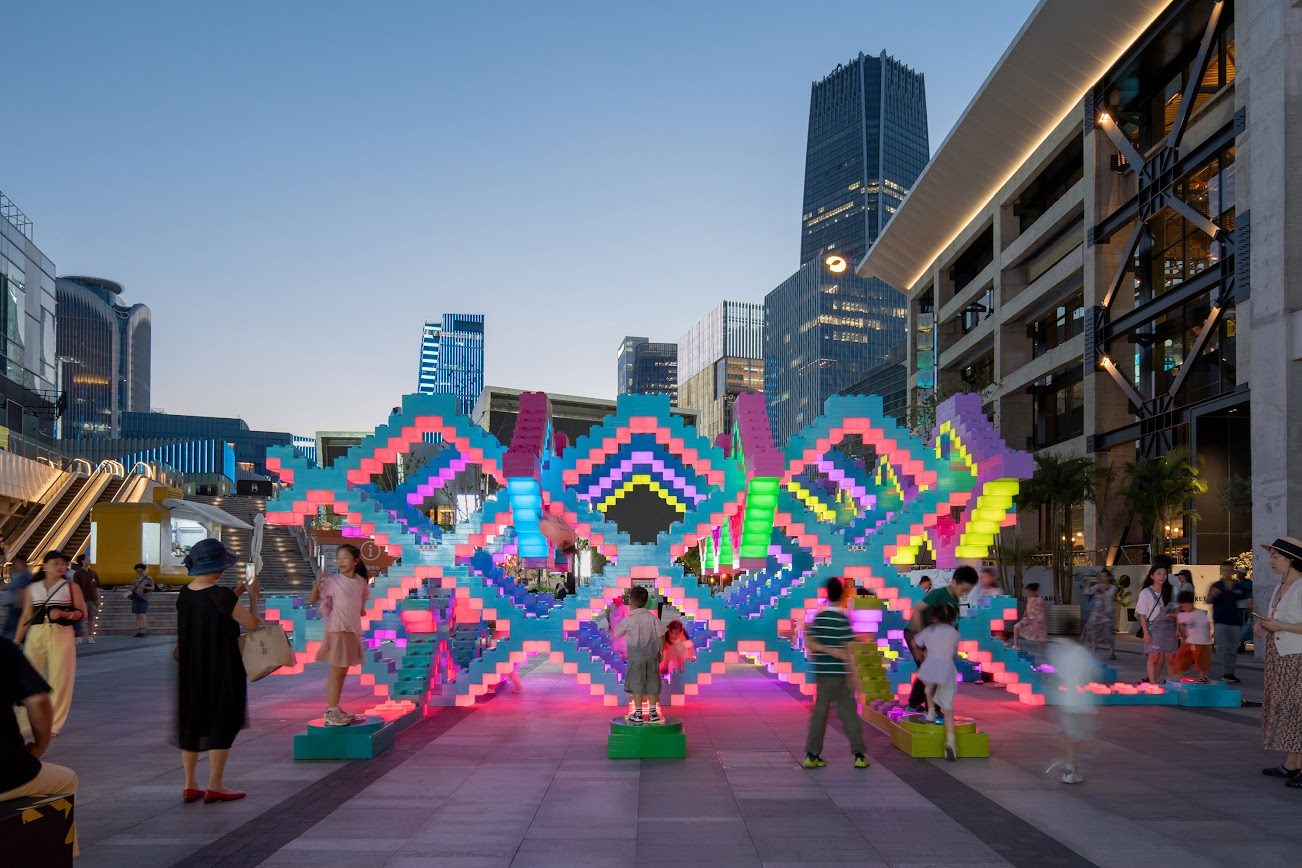
At twilight, light transforms the modular lattice into a luminous urban landmark along Shanghai's West Bund waterfront. Photography: ZHANG Chao, TIAN Fangfang.
The Lightweaving Playground: Daxing Jizi Design Weaves a New Language of Urban Play
WAAR Editorial · 7 min read
Through an imaginative interplay of traditional weaving, modular construction, light and human interaction, Xie Qiongzhi and Daxing Jizi Design challenge conventional ideas of public space. The result is an installation that places creativity, participation and the experience of the human body at the centre of the urban environment.
At WAAR – World of Architecture, Arts & Refined Living, we are interested in projects that move beyond the conventional boundaries of architecture and design to reconsider how people experience the spaces around them. The Lightweaving Playground, created by Daxing Jizi Design for LEGO® World Play Day in Shanghai, is one such exploration.
Rather than approaching public art as a static object within the city, the project considers how a designed environment can become an active participant in everyday urban life. Through its woven modular structure, responsive lighting and interactive elements, it transforms a public setting into an immersive landscape where movement, imagination and social interaction become part of the design itself.
RECLAIMING THE SPIRIT OF PLAY
The intellectual foundations of the project draw from an enduring question in twentieth-century architecture and urbanism: what happens when cities prioritise efficiency at the expense of imagination?
In developing The Lightweaving Playground, Xie Qiongzhi looked to the visionary ideas of Dutch artist and architect Constant Nieuwenhuys, whose influential concept of New Babylon imagined a fluid, playful urban world shaped continuously by human creativity. Nieuwenhuys proposed a future in which architecture would no longer dictate rigid patterns of behaviour, but instead serve as a flexible framework for exploration, encounter and joy.
The Lightweaving Playground translates this philosophy into a tactile and accessible public installation. Rather than offering fixed instructions or predetermined routes, the structure encourages visitors to invent their own ways of engaging with the space.
Six interactive jumping buttons anchor the experience. When visitors step or leap onto them, the installation responds with waves of colour and playful 8-bit sound effects reminiscent of classic video games. Movement becomes the catalyst that activates the architecture, turning the installation into an environment that feels alive and responsive to human presence.
WEAVING A NEW URBAN LANGUAGE
Weaving occupies a distinctive place in architectural and cultural history. Long before industrial construction methods emerged, woven structures demonstrated how simple repeating elements could be combined to create shelter, strength and spatial rhythm.
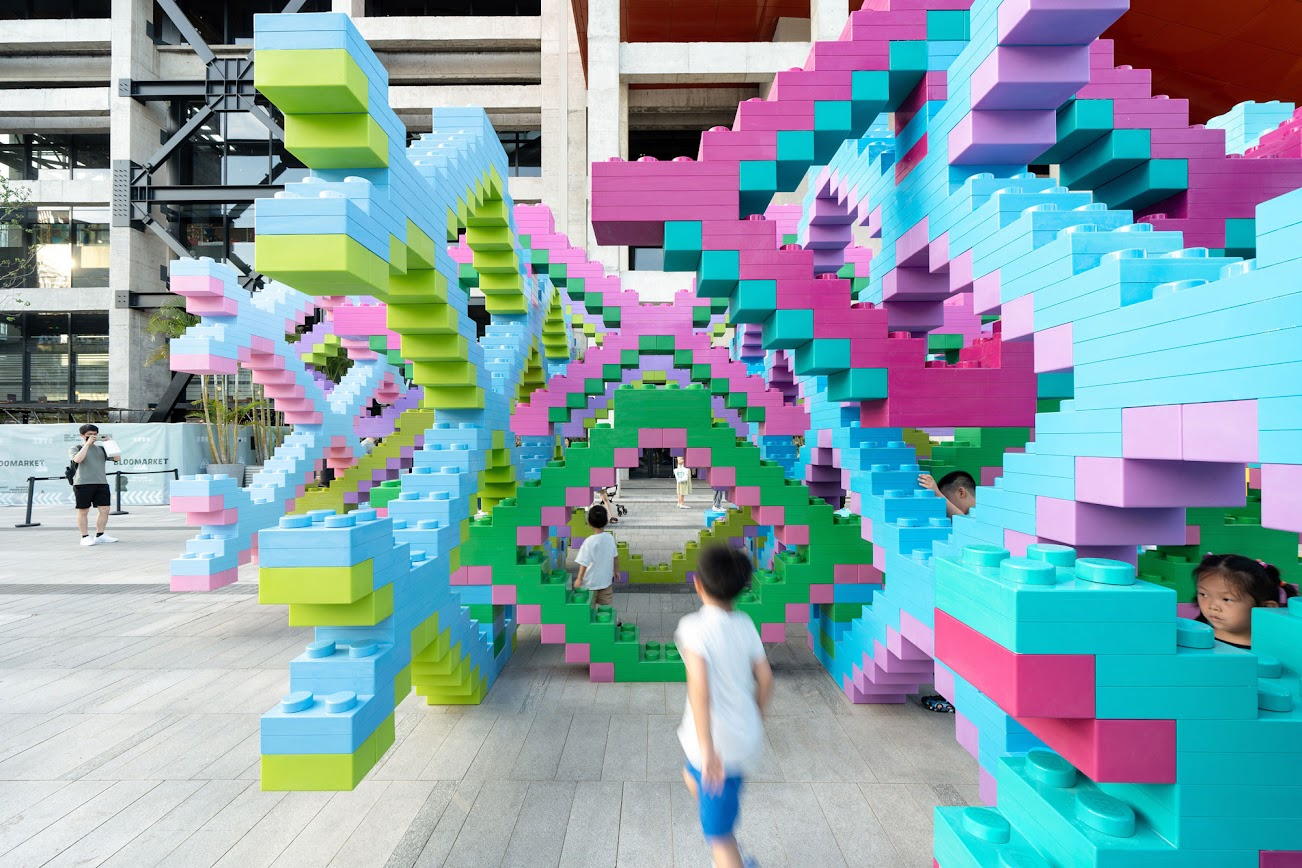
Daxing Jizi Design draws on this lineage while reimagining it through a contemporary visual and structural language. The Lightweaving Playground takes the familiar logic of interlacing threads and translates it into a three-dimensional modular system inspired by the geometric versatility of LEGO® bricks.
Constructed from stepped modular units, the installation forms a continuous architectural lattice of arches, openings and overlapping surfaces. Its geometry feels both structured and open-ended. Rather than presenting an enclosed barrier, the woven form creates a porous field through which light, sightlines and people move freely.
In doing so, the project achieves a compelling balance between craft and modularity. The regularity of the pixel-like building blocks evokes digital culture and contemporary play, while the interlacing pattern connects the structure back to ancient traditions of making. It is a spatial language that feels immediately approachable yet architecturally sophisticated—one where playfulness does not come at the expense of formal clarity.
The structure itself is not merely a backdrop for activity. It acts as an architectural filter, softening the surrounding urban context while creating a defined realm of colour, shadow and enclosure. Visitors are neither fully inside nor completely outside; they inhabit an in-between space that celebrates permeability, softness and structure.
WHEN LIGHT BECOMES A MATERIAL
Light is central to the installation's identity—not as an added decorative effect, but as a primary spatial medium.
During the day, natural sunlight moves across the installation's colourful stepped surfaces, casting intricate geometric shadows across the ground and constantly altering the visual rhythm of the space. The woven openings frame shifting views of the city and passers-by, integrating the surrounding waterfront plaza into the experience of the work.
As evening arrives, the character of The Lightweaving Playground undergoes a dramatic transformation. Integrated lighting awakens the structure from within, turning its geometric lattice into a luminous urban landmark. Saturated hues of blue, green, magenta, orange and yellow flow across the woven framework, transforming the installation into an ever-changing canvas of light.
Importantly, this illumination is never passive. Because the lighting responds directly to human interaction, the visual identity of the installation is continually co-authored by its visitors. A single step triggers ripples of colour; multiple participants jumping together produce layered, dynamic patterns that travel across the entire structure.
In this sense, light operates as an invisible thread connecting people across the plaza. Strangers become collaborators in an improvised choreography of movement, colour and sound—turning individual moments of play into a collective visual performance.
DESIGNING THE CITY FROM A CHILD'S PERSPECTIVE
An important dimension of the project is its insistence on viewing the city through the lens of children—not as passive recipients of adult-designed infrastructure, but as imaginative, independent participants in urban life.
The installation reflects The LEGO Group's broader global initiative encouraging cities to become more playful, inclusive and responsive to younger generations. Rather than isolating play within conventional fenced playgrounds equipped with standardised equipment, The Lightweaving Playground embeds play directly into the cultural fabric of the public plaza.
The openness of the design is key to its success. Children run through the arches, peer through the geometric apertures, experiment with the illuminated buttons and invent spontaneous games with others they have only just met. Adults, drawn in by the visual warmth and energy of the installation, frequently find themselves stepping onto the interactive pads alongside them.
As one visitor observed during the exhibition, "Children know how to play better than adults." The remark captures the quiet brilliance of the project: by creating an environment without rigid rules, The Lightweaving Playground invites people of all ages to rediscover curiosity, spontaneity and shared joy.
In contemporary cities where public space is often heavily programmed or commercially driven, this emphasis on unstructured play feels remarkably refreshing. It reminds architects, planners and civic leaders that some of the most memorable urban experiences emerge not from control, but from generosity—when the environment makes room for it.
PUBLIC ART AS AN URBAN EVENT
For Daxing Jizi Design, the significance of public art lies not only in its physical form, but in its capacity to generate shared urban moments.
Positioned at Gate M, West Bund Dream Center in Shanghai—a district increasingly recognised for its cultural institutions, waterfront promenades and public programming—The Lightweaving Playground operated as a magnetic social condenser throughout its exhibition period from 11 June to 27 July 2025.
Covering an area of 126.36 square metres, the installation achieved remarkable presence without relying on monumental scale. Its intimacy was part of its strength. Close enough to be touched, navigated and activated by hand and foot, it transformed an everyday urban plaza into a stage for encounter.
Families gathered around its illuminated arches at dusk; passers-by paused to watch colour patterns ripple across its woven surfaces; children turned the modular structure into a labyrinth of light and sound. Over the course of its run, the installation ceased to be simply an object placed within the city—it became an event woven into the rhythm of Shanghai's summer evenings.
In this way, The Lightweaving Playground exemplifies a broader shift in contemporary public art and spatial design: away from distant, untouchable monuments and towards participatory environments that foster human connection.
Projects such as this remind us that architecture and public art are at their most compelling when they engage the senses, invite participation and create space for joy. By weaving together craft traditions, modular play and interactive light, Daxing Jizi Design has offered a vivid glimpse of what cities can become when they leave room for imagination—and for people of every generation to feel free to play.
RETHINKING THE POSSIBILITIES OF PUBLIC SPACE
The Lightweaving Playground offers more than a festive installation for a single occasion. It presents a thoughtful architectural proposition about the future of public space.
At a moment when urban life is increasingly mediated by screens and individual routines, the project uses light, sound and modular architecture to draw people back into shared physical space. Its interactive mechanisms do not isolate participants in private digital worlds; instead, they amplify bodily movement, eye contact, laughter and collective discovery.
Equally compelling is the studio's ability to unite conceptual depth with immediate emotional accessibility. Beneath its vibrant colours and playful energy lies a disciplined architectural intelligence—one informed by urban theory, structural clarity, material sensitivity and an acute understanding of human behaviour.
Through this balance, Xie Qiongzhi and Daxing Jizi Design demonstrate that serious architectural thinking does not need to feel austere. Joy, colour, craft and experimentation can be powerful instruments for reimagining contemporary public space.
XIE QIONGZHI & DAXING JIZI DESIGN
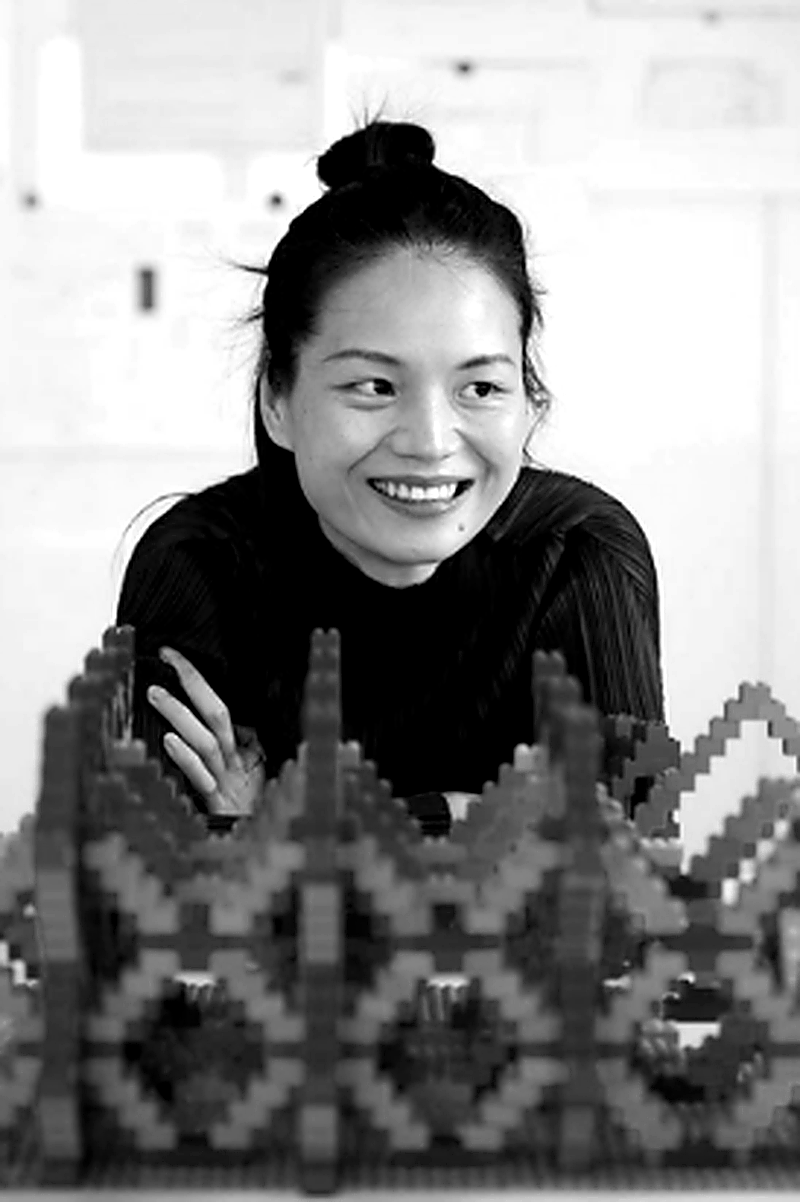
Xie Qiongzhi is an installation artist and the founder and lead designer of Daxing Jizi Design. Her practice explores the relationship between the human body, spatial perception and contemporary urban environments, creating public art installations and spatial works that invite direct physical and emotional participation.
Through interdisciplinary collaboration across architecture, art, lighting and interactive media, her work seeks to soften the boundaries between built form and everyday life—transforming public spaces into responsive environments for encounter, play and reflection.
Founded in Shenzhen in 2023 by Xie Qiongzhi and Zeng Zhenwei, Daxing Jizi Design is an innovative architectural and spatial design studio dedicated to public art, urban installations and experimental spatial environments. Guided by a commitment to curiosity, craftsmanship and human-centred design, the studio creates works that reimagine how people interact with architecture, culture and the contemporary city.
WAAR TV · Film
See the LEGO® World Play Day public art installation in motion, with light, sound and interactive play captured at Shanghai's West Bund.
Watch The Lightweaving Playground film on WAAR TV →Credit
Project Information
Project: LEGO® World Play Day – The Lightweaving Playground
Project type: Public art installation
Design studio: Daxing Jizi Design
Lead designer: Xie Qiongzhi
Key team members: Zeng Zhenwei, Chen Yingxiao, Zhang Xubin
Construction consultant: AND office
Client: The LEGO Group
Area: 126.36 m²
Location: Gate M, West Bund Dream Center, Shanghai, China
Launch date: 11 June 2025
Exhibition period: 11 June – 27 July 2025
Photography: ZHANG Chao, TIAN Fangfang