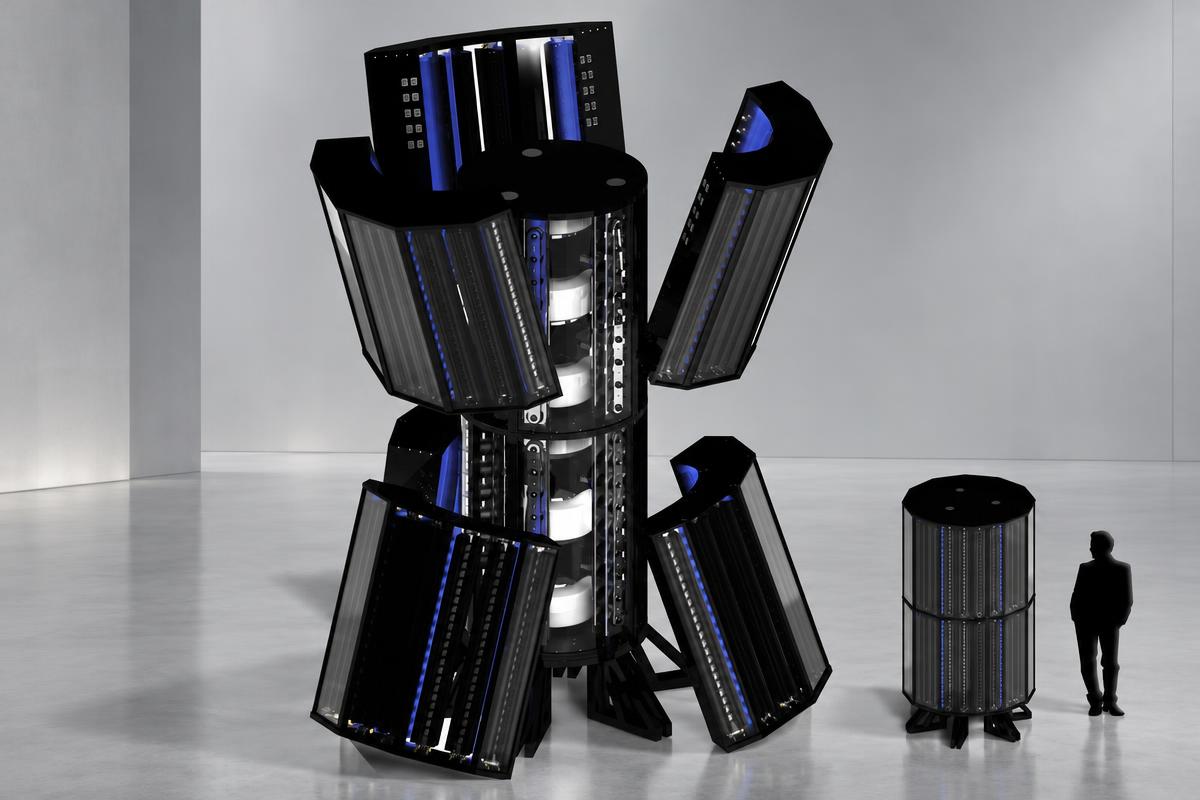
OPERA ONLY · Expanded and closed forms with a human silhouette conveying scale.
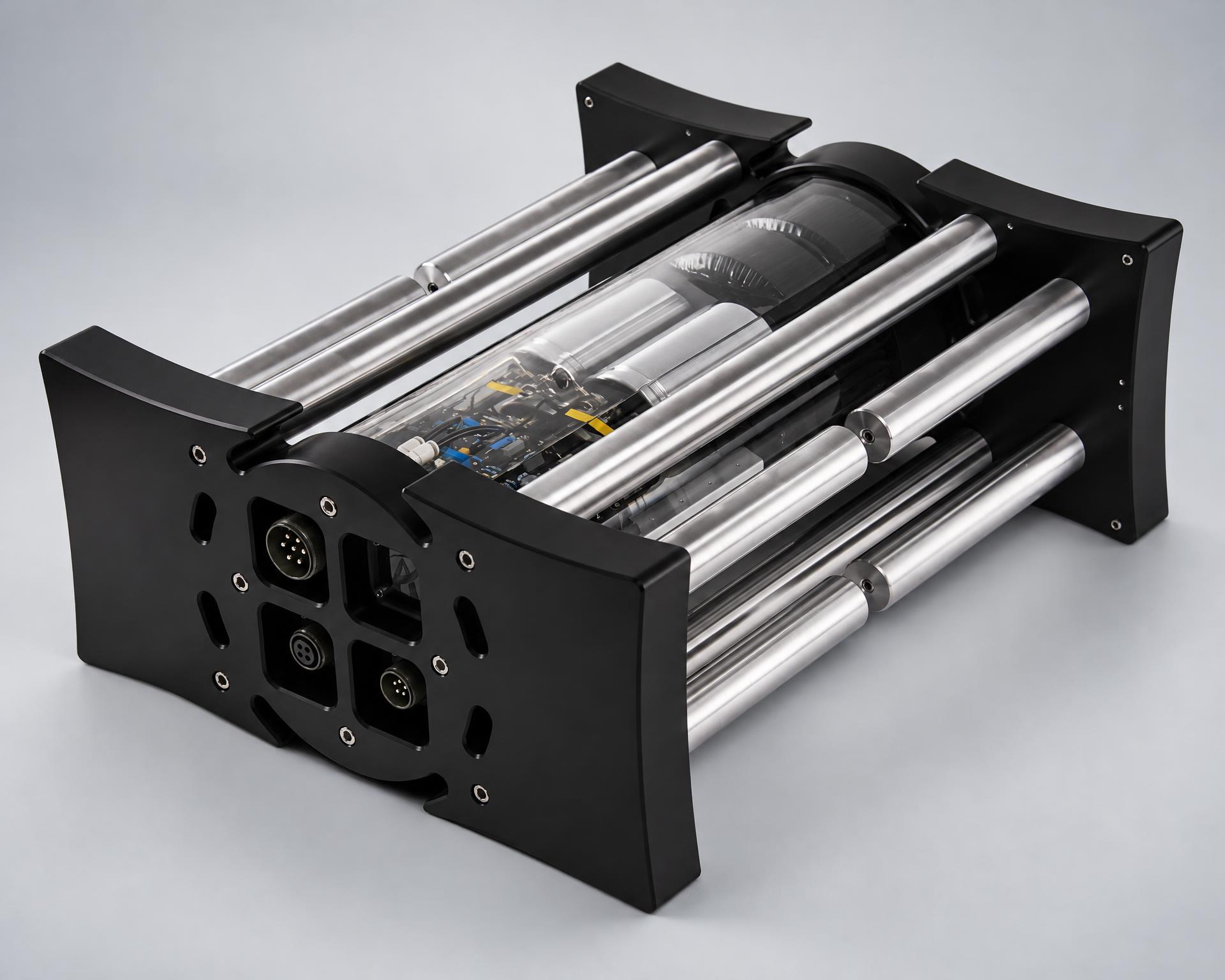
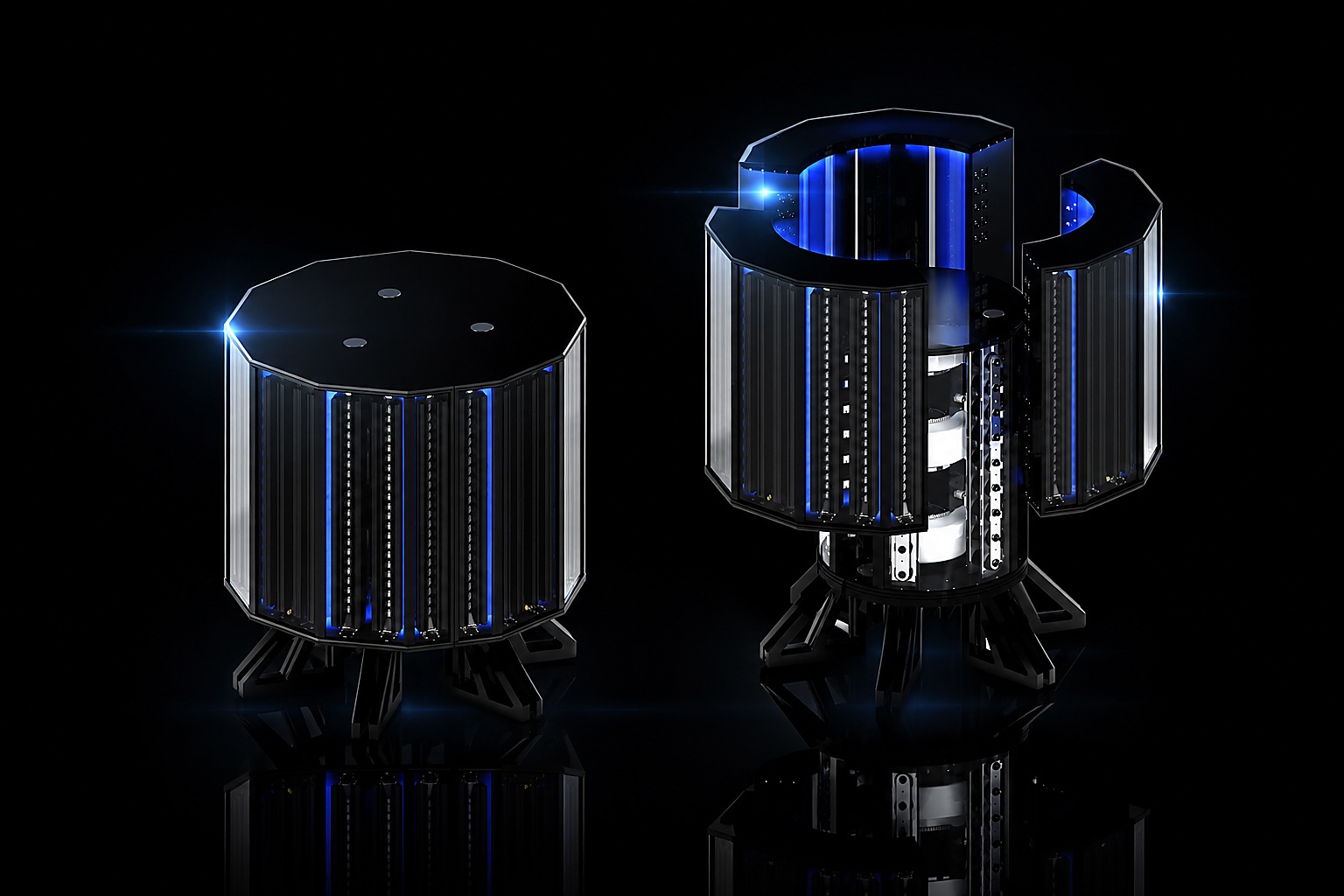
SILENTE · The transparent cylinder makes the electronic architecture visible within the surrounding frame. Pivetta describes its nanofluid research in the interview.
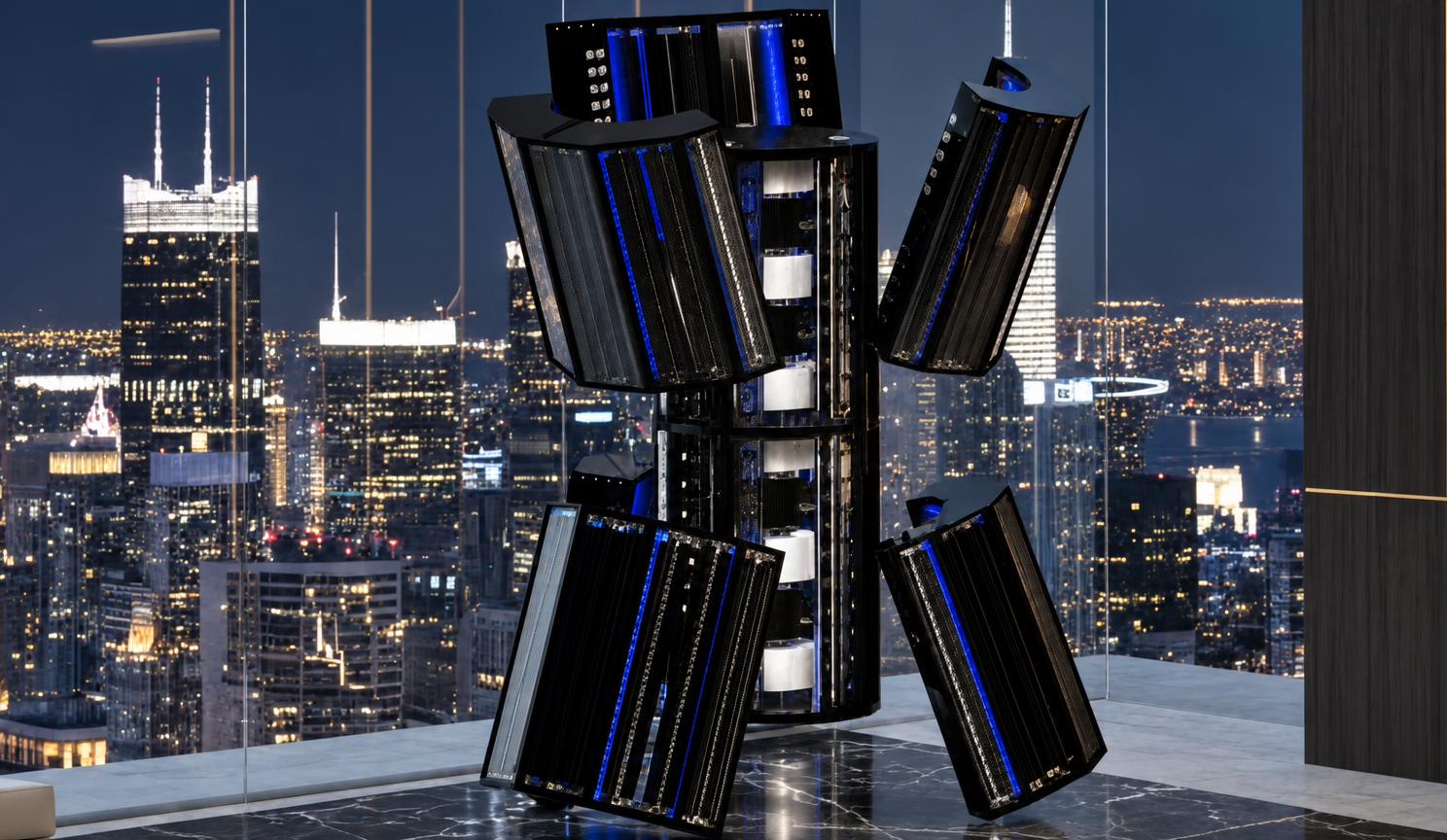
OPERA ONLY · Set against a night skyline, the kinetic work's opened modules read as architecture in their own right.
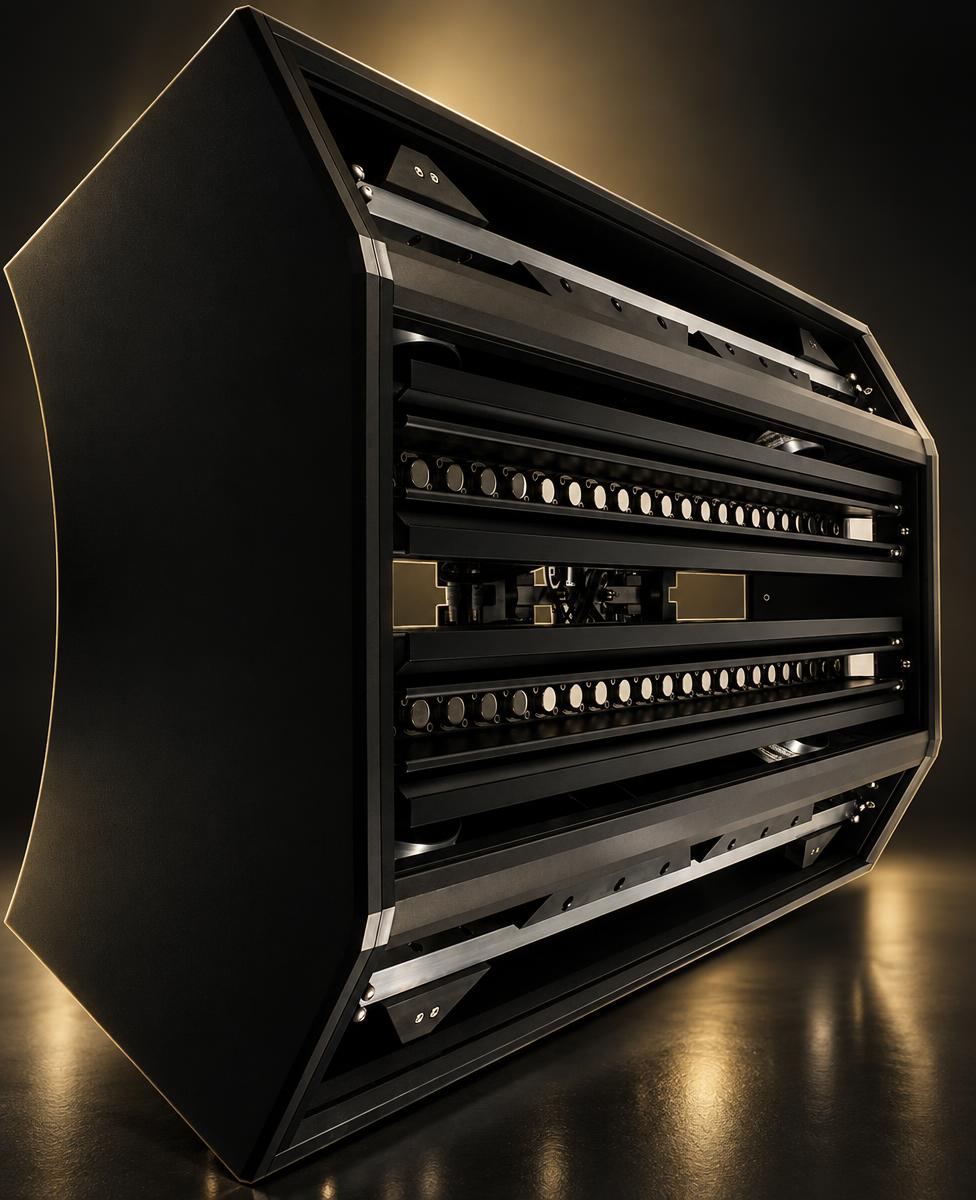
POWERONE · Precision rails and exposed driver arrays give the work its sculptural, architectural character.
Andrea Pivetta: Where Engineering Meets Art, Architecture and Imagination
WAAR Editorial · 16 min read
There are individuals who work within the established boundaries of design, and there are those who dedicate their lives to questioning where those boundaries should exist. Andrea Pivetta belongs to the latter.
An Italian designer, inventor and creative technologist, Pivetta has spent more than four decades exploring the relationship between engineering, electronics, mechanics, art and design. His creations challenge conventional expectations of functional objects, transforming sophisticated technological systems into expressive works that engage with movement, architecture and space.
Based in the province of Vicenza, Italy, his creative journey began remarkably early. Inspired by his father’s passion for mechanics, music and electronics, Pivetta developed an interest in understanding how things work. At twelve, he was already repairing and modifying vintage RCF audio equipment. By fourteen, he had designed and built an amplifier with features he recalls as difficult to find in commercially available equipment at the time.
That early curiosity evolved into a lifelong philosophy: to imagine what does not yet exist and find a way to make it real.
From the monumental kinetic creation OPERA ONLY to the experimental audio engineering of SILENTE and the expressive sculptural language of OLTRE, his work occupies an unusual territory where technology becomes art and function becomes an experience.
In this exclusive conversation with WAAR, Andrea Pivetta reflects on his creative philosophy, the stories behind his most distinctive creations, his relationship with architecture and the technological frontiers that continue to inspire his work.
01. THE CREATIVE PHILOSOPHY
WAAR: You have personally developed your creations for more than forty years, from the initial engineering concept to the finished work. What does this independence make possible, and how has your philosophy evolved?
Andrea Pivetta
My story with technology has deep roots, going back to my childhood. My father had a great passion for mechanics, music and electronics, and it was he who first sparked my interest, introducing me to a world that would accompany me throughout my life.
From a very young age, I was drawn to everything involving mechanisms, electricity and the way things work. I was fascinated by shapes, structures and the way different elements could come together to create something new.
What began as curiosity soon became a true passion. I did not yet know where it would lead me, but I already felt the desire to understand, experiment, design and, above all, create.
In 1983, at just twelve years old, I began repairing and modifying vintage RCF audio equipment. It was one of the first concrete steps in a journey that has never stopped. By 1985, at the age of fourteen, I had already designed and built an amplifier with features and performance that were difficult to find in the equipment available on the market at the time.
Over the years, that passion evolved into a creative philosophy: not simply to improve what already exists, but to seek new paths, imagine solutions and turn ideas into reality.
I chose to work largely independently because I have always wanted to personally oversee every stage of creation, from the first idea to the finished work.
My works often begin with an image that is already very clear in my mind, a vision that encompasses both the aesthetic form and the way it can be technically achieved. Personally following this process allows me to maintain continuity between the original idea and the completed work.
This does not mean rejecting dialogue with others. I am always open to the ideas, experiences and points of view of those around me. However, I feel it is essential that the creative direction and identity of a project remain true to the vision from which they originated.
In my atelier near Vicenza, an idea does not necessarily have to adapt to existing technologies or conventional production logic. Technology must evolve and find a way to give form to the vision.
My atelier is a private creative workshop, a personal workspace whose overall character has remained essentially unchanged over the years. In its size and approach, it is more like a goldsmith's workshop than a large production facility. It is the place where I continue to devote myself personally to the design and creation of my works.
Every work begins in my imagination, takes shape through drawings and design studies, and gradually develops in every detail. From conceiving the structures to electronic design, through construction and assembly, the creative and realisation process remains entirely in my hands.
My journey has also been profoundly influenced by the environment in which I grew up. The province of Vicenza has a prestigious manufacturing culture founded on precision, quality and the ability to bring tradition and innovation together. The Vicenza goldsmithing tradition, in particular, demonstrates how technical expertise and aesthetic sensibility can coexist.
Not far away, Venice and Murano represent another extraordinary expression of Italian artistic tradition, especially in glassmaking. This culture has contributed to my sensitivity towards materials and their expressive possibilities.
Over more than forty years, my work has evolved profoundly, moving from electronics and audio engineering towards a much broader field of research, where technology, design, architecture and movement come together.
Yet the spirit remains the same as that of the child who wanted to understand how things worked: the curiosity to discover what does not yet exist and the desire to make it possible.
02. WHEN ENGINEERING MEETS ART
For Pivetta, the relationship between engineering and artistic expression is not a matter of combining two disciplines after a design has been completed. It is a process in which aesthetics, mechanics and technological innovation develop together from the very beginning.
His creations reflect a philosophy in which technical complexity is not something to conceal, but an essential part of the artistic identity.
WAAR: Your work moves between engineering, technology and artistic expression. At what point do the boundaries between these disciplines disappear, and what does that intersection allow you to create?
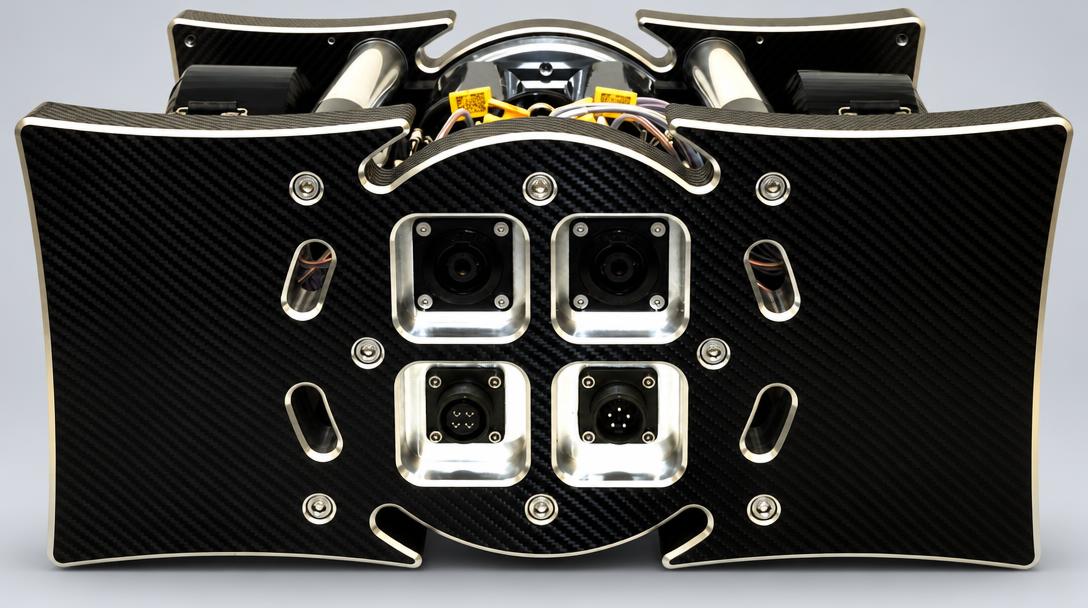
Andrea Pivetta
I have always seen creativity as a territory without clearly defined boundaries. From a young age, I was drawn to understanding and connecting different disciplines, from mechanics to electronics, from physics to design. I have never seen these fields as separate worlds, but as complementary tools for giving shape to my ideas.
In my creative process, art and engineering are not two separate stages. They often coexist from the very first idea. When I imagine a new creation, its aesthetic identity, structure, mechanisms and the way it will function begin to take shape in my mind at the same time.
It is an ongoing dialogue between imagination and design. On one side is the desire to create something with a strong visual and emotional presence; on the other, the need to find the technical and engineering solutions that will make it possible.
Sometimes a particular aesthetic intuition calls for the development of an entirely new technological solution. At other times, a technical possibility suggests a new form of expression. It is this reciprocal exchange that makes the creative process so stimulating.
When the available technologies are not sufficient to realise the vision, I look for a different approach rather than automatically scaling back the idea to fit conventional solutions.
I do not see design as a mere aesthetic covering applied to technology, nor engineering as a means intended solely to fulfil a function. Both must emerge together, contributing to the same identity.
I believe a creation reaches its full potential when engineering complexity becomes an integral part of its beauty, and when its form is not simply pleasing to look at, but also expresses the technological principle that makes it possible.
It is through this encounter that an object can move beyond its original function and become something different: a work in which technology, aesthetics and emotion are inseparable.
03. THE STORY BEHIND OPERA ONLY
Among Andrea Pivetta's most ambitious creations is OPERA ONLY, a monumental kinetic work that challenges the conventional understanding of audio equipment.
Its origins can be traced to OPERA ONE, conceived in 1996 and completed in 1998. The original creation introduced a remarkable idea: an amplifier that was not simply designed to produce sound, but also to transform physically through an elaborate movement system.
In 2011, Pivetta revisited the concept, setting out to develop something considerably more ambitious. The result was OPERA ONLY, completed in 2013, bringing together technological complexity, sculptural expression and architectural scale.
WAAR: OPERA ONE was completed in 1998; OPERA ONLY later brought that kinetic ambition to an architectural scale. What inspired the concept? Was movement integral from the beginning, and what do you hope people experience as the work transforms?
Andrea Pivetta
Music has always stirred deep emotions in me. This inspired my desire to give life to the instrument that makes it possible as well. I no longer wanted to think of an amplifier as a simple container for electronic components, but as a work with its own identity, expressed through form and movement.
OPERA ONE, which I began designing in 1996 and completed in 1998, was an early expression of this idea: to create a kinetic work of art that was also a fully functioning amplifier.
It was already a special creation, but it stood about one metre tall. Its cylindrical structure was almost 80 centimetres in diameter and was designed to open through a movement system, reaching a width of nearly two metres as it transformed.
In 2011, looking back at that project, I decided to go much further and began designing something far more ambitious, with an almost space-age presence and a level of technological complexity capable of going beyond what had been achieved up to that point. The project was completed in 2013.
That is how the idea for OPERA ONLY came about. I wanted to go further not only in audio and electronics, but also in technological art: not simply to create a larger or more powerful amplifier, but a true work of art in which technology, architecture, movement and function could coexist in an entirely new dimension.
In the years that followed, the project evolved further, leading to an even more powerful configuration.
In OPERA ONLY, movement became an integral part of the project from the very first concept. The structure opens to reveal what normally remains hidden: the technology, the internal architecture and the engineering complexity that make the work function.
This solution is not merely aesthetic or theatrical; it also responds to specific functional requirements, including thermal management. Once again, design and engineering must coexist and contribute to a unified concept.
I have never been particularly drawn to purely static works. Movement interests me because it introduces another dimension: the possibility for a creation to change, transform and gradually reveal its nature.
My wish was for music not only to be heard, but for the technology capable of generating it to become an experience to observe and engage with. A work in which sound meets architecture and movement, transforming an amplifier into something that goes far beyond its original function.
04. INNOVATION BEYOND SOUND
If OPERA ONLY explores the expressive possibilities of movement, SILENTE takes Pivetta's research into the more discreet territory of vibration, resonance and electronic stability.
Combining a proprietary stabilising nanofluid, a precision-engineered aluminium structure and Murano glass, SILENTE is an exploration of how advanced engineering and traditional craftsmanship can coexist within a single creation.
His curiosity about waves and resonance, however, began long before SILENTE. As a teenager, he was already experimenting with acoustic levitation and standing sound waves.
WAAR: In SILENTE, your proprietary nanofluid surrounds the electronics within a Murano glass cylinder. What were you seeking to address, how does the fluid respond to vibration and resonance, and why glass? Could this research have applications beyond audio?
Andrea Pivetta
With SILENTE, I wanted to explore a different approach to one of the most delicate aspects of audio engineering: the relationship between electronics, vibration and resonance.
My interest in waves and resonance phenomena began very early. At the age of fourteen, while experimenting with electronics and building my first amplifiers, I was also conducting acoustic levitation experiments based on standing sound waves. I was fascinated by the possibility of observing and understanding how vibrations could produce tangible physical effects. Over time, this curiosity developed into a line of research that led me to explore vibration and resonance in electronics, giving rise to SILENTE.
This research led to the development of a proprietary stabilising nanofluid of my own conception, in which the entire electronic architecture is immersed. The fluid acts as an advanced mechanical damper, helping to shield the components from micro-vibrations and acoustic feedback while isolating the internal architecture from subtle structural resonances.
Together with the precision-engineered, watertight aluminium frame, which provides exceptional structural stability and minimises micro-oscillations, the nanofluid creates a highly controlled environment for the electronic system. The aim is to reduce unwanted mechanical interference and preserve the purity of the audio signal.
I chose Murano glass to enclose this system also for its strong symbolic and aesthetic value. I was fascinated by the idea of bringing a prestigious Italian craft tradition into dialogue with contemporary technological research. The transparent cylinder also makes visible what normally remains hidden inside an electronic device.
SILENTE stems from research aimed at reducing unwanted vibration and resonance, with the goal of preserving signal purity and allowing even the finest musical details to emerge. The principles explored through this research may also offer interesting possibilities in other technological and industrial fields, beyond audio.
Over time, my study of waves, frequencies and resonance phenomena has also led me to look towards new horizons: aerospace propulsion. This research gave rise to RPS – Resonant Propulsion System, a project currently under development and based on resonance and wave physics. Conceived to explore scenarios beyond the principles of conventional propulsion, the project extends towards perspectives involving flight dynamics and space technologies.
For me, SILENTE is one stage in a broader journey of research: rather than automatically accepting conventional solutions, I seek new paths whenever an intuition suggests a different possibility.
05. THE WORKS, THEIR SPACES AND NEW PERSPECTIVES
Pivetta's work raises an interesting question for contemporary architecture and interior design: what happens when a functional object becomes a defining element of a space?
His creations are not conceived simply to occupy a room. They are intended to establish a relationship with their surroundings, whether through their sculptural form, material expression or technological character.
OLTRE, in particular, demonstrates this openness to interpretation. Its forms can suggest natural movements, musical references or abstract compositions, leaving the observer free to establish an individual connection with the work.
Beyond the objects themselves, Pivetta is also exploring new ways of making his creative and technical experience available to companies, brands and organisations through SYNERGY, his initiative for creative and technical consultancy.
WAAR: Your works engage with a space rather than simply occupy it. How do you see them within architecture and interiors, have you collaborated directly with design studios, and which new frontiers are you exploring?
Andrea Pivetta
My works are created to engage with space and architecture, without necessarily being tied to a particular style.
OLTRE, for example, can sit harmoniously in contemporary, minimalist settings, but also in historic or classical architecture. I am fascinated by the possibility that a distinctly contemporary work can create an unexpected dialogue with architectural contexts from different eras.
My creations are works of design that bring artistic expression and function together. They can be used for their intended purpose, but they can also be appreciated purely as works of art. Some collectors, in fact, have chosen my creations primarily for their aesthetic value, without necessarily using them as audio equipment.
OLTRE, in particular, leaves considerable room for the imagination of the person observing it. Its forms may evoke the waves of the sea, a musical movement, a fragment of a guitar or many other images. I do not wish to impose an interpretation; I prefer each observer to find their own.
OPERA ONLY represents a different dimension, in which technology, monumentality and movement become an integral part of the artistic experience.
My works have been chosen by collectors and enthusiasts of the luxury audio world, but also by architects, who have placed them in private residences and prestigious villas. I have not yet developed direct collaborations with architecture or interior design studios on specific environments, but I consider this dialogue a very interesting prospect. I believe my creations could also find a natural place in major architectural projects and prestigious spaces.
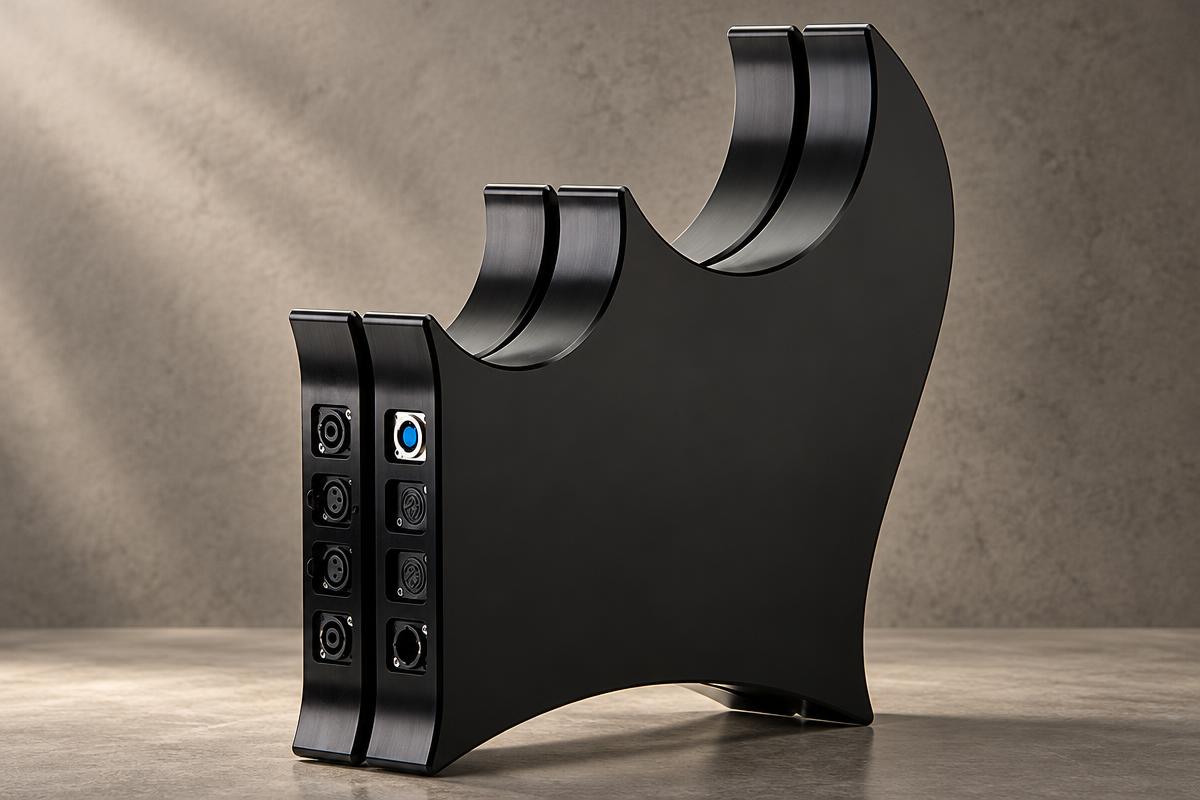
My work does not follow the logic of standardised product manufacturing. The works presented on my website are original creations, conceived and made by me, and they represent my vision and creative journey.
Each creation begins with a private commission or a special project. This means that clients are not necessarily asked to choose from existing works: they can share an idea, a need or a vision, giving rise to an entirely new project.
It does not necessarily have to be an amplifier; it could also be a functional sculpture, a kinetic structure or a work with specific forms and characteristics, conceived to engage with a space and with the sensibility of the person commissioning it.
It is precisely this creative freedom that allows me to turn an intuition into an exclusive work, personally guiding its journey from conception to completion.
My interest in innovation applied to different sectors goes back many years. I had already designed a vehicle capable of moving without a driver on board, using remote-control systems and autonomous driving. This experience shows how my research has always extended into mechanics, automation and new technological possibilities. The Jeep Dance project was also presented on Italian national television, on RAI, in 1989.
Today, I would also like to make this experience available to companies and brands in different sectors through an activity that brings creative and technical consultancy together.
I have dedicated a specific section of my website, SYNERGY, to this possibility: offering my design vision, technical experience and inventive ability to contribute to the development of concepts, products and innovative solutions.
My role as a Creative & Technical Consultant can extend from concept design to technical and creative consultancy, and to the development of project synergies and licensing agreements. I am interested in connecting with organisations that wish to explore new possibilities, take on design challenges or give shape to ideas that call for an unconventional perspective.
As for the future, I continue to follow my curiosity and desire to explore new territories, without limiting myself to a single field. For me, every new line of research is an opportunity to turn an intuition into something that does not yet exist.
I believe my growth has been driven above all by curiosity, direct experience and the desire to go beyond the limits of what I already know. I have never wanted to follow a predetermined path: I prefer to let ideas and intuitions point me towards new directions.
Even today, after so many years, the principle remains the same: to imagine something that does not exist, find a way to make it real and transform it into a work with its own identity.
BEYOND THE OBJECT: THE ENDURING POWER OF IMAGINATION
Andrea Pivetta’s journey offers a compelling perspective on what becomes possible when creativity is not restricted by conventional disciplines.
From his earliest experiments with electronics to the kinetic engineering of OPERA ONLY, the material exploration of SILENTE and the sculptural expression of OLTRE, his work reflects an enduring commitment to invention, individuality and technical discovery.
For architects and interior designers, his creations introduce an alternative understanding of functional objects: one in which technology becomes part of an artistic and spatial experience. For collectors, they offer original works developed through a deeply personal creative process. For businesses and innovators, SYNERGY opens a dialogue around potential collaborations in other industries.
Perhaps the most interesting aspect of Pivetta’s philosophy is that he has never regarded his work as belonging to a single category. His interests move freely between art, engineering, mechanics, architecture and technological research. His discussion of RPS describes research in development, not a demonstrated or commercially validated propulsion technology.
In a world increasingly shaped by technological advancement and standardised production, his approach is a reminder that meaningful innovation often begins with something more fundamental: the freedom to imagine differently.
After more than forty years, his guiding principle remains unchanged: to imagine something that does not exist, discover how to make it possible and transform it into a creation with an identity of its own.
That is where engineering meets art. And that is where imagination begins to take form.
Credit
Andrea Pivetta · In conversation with WAAR