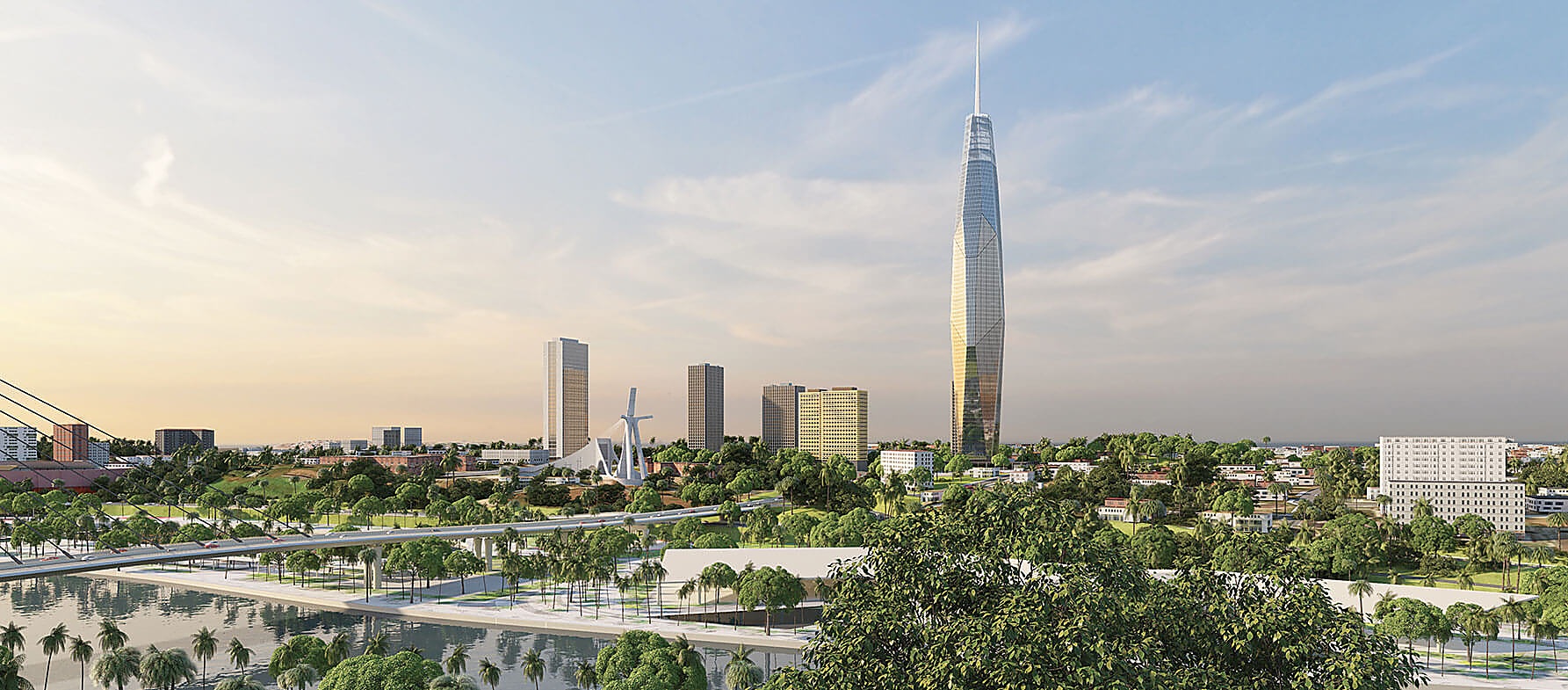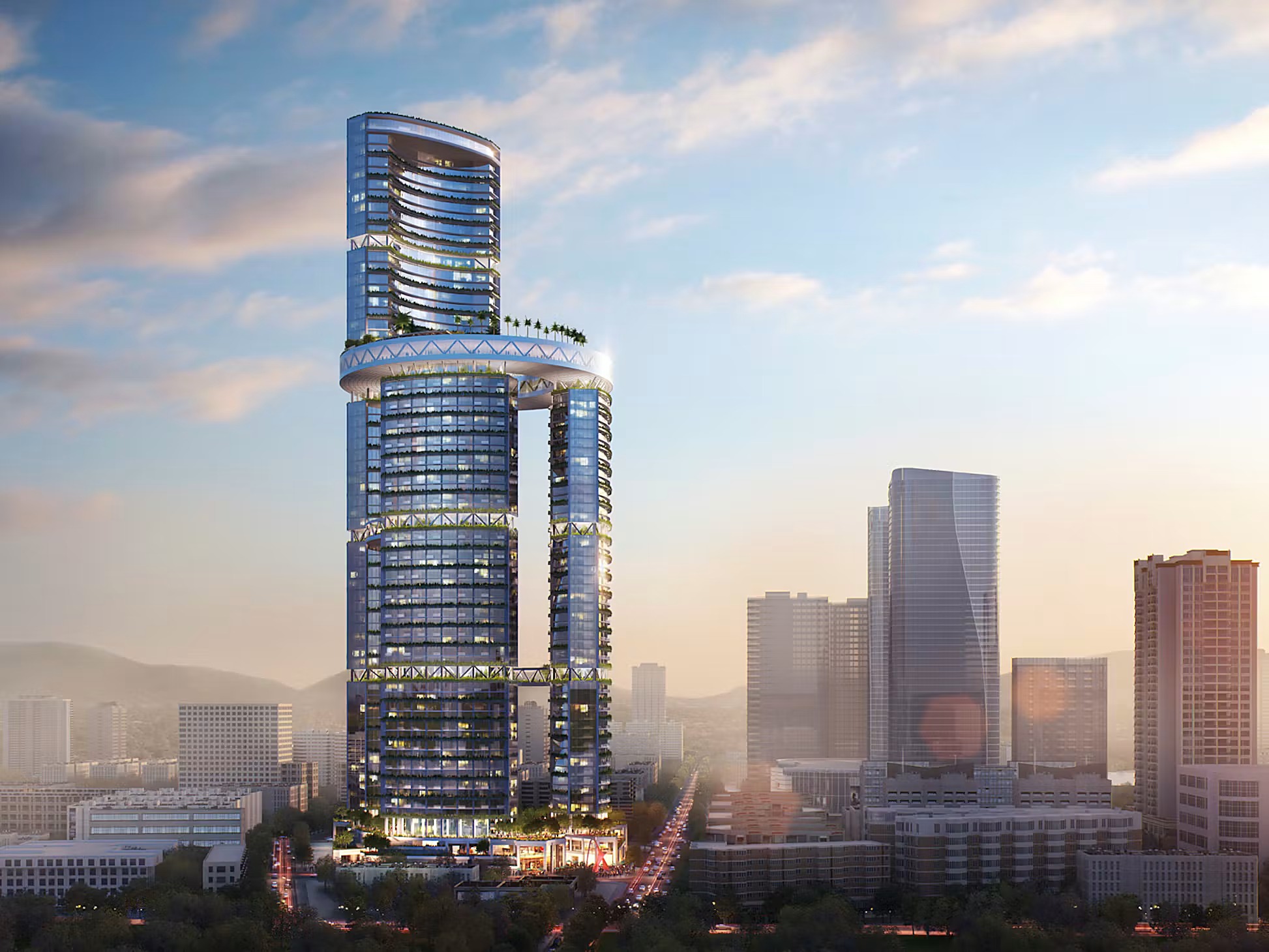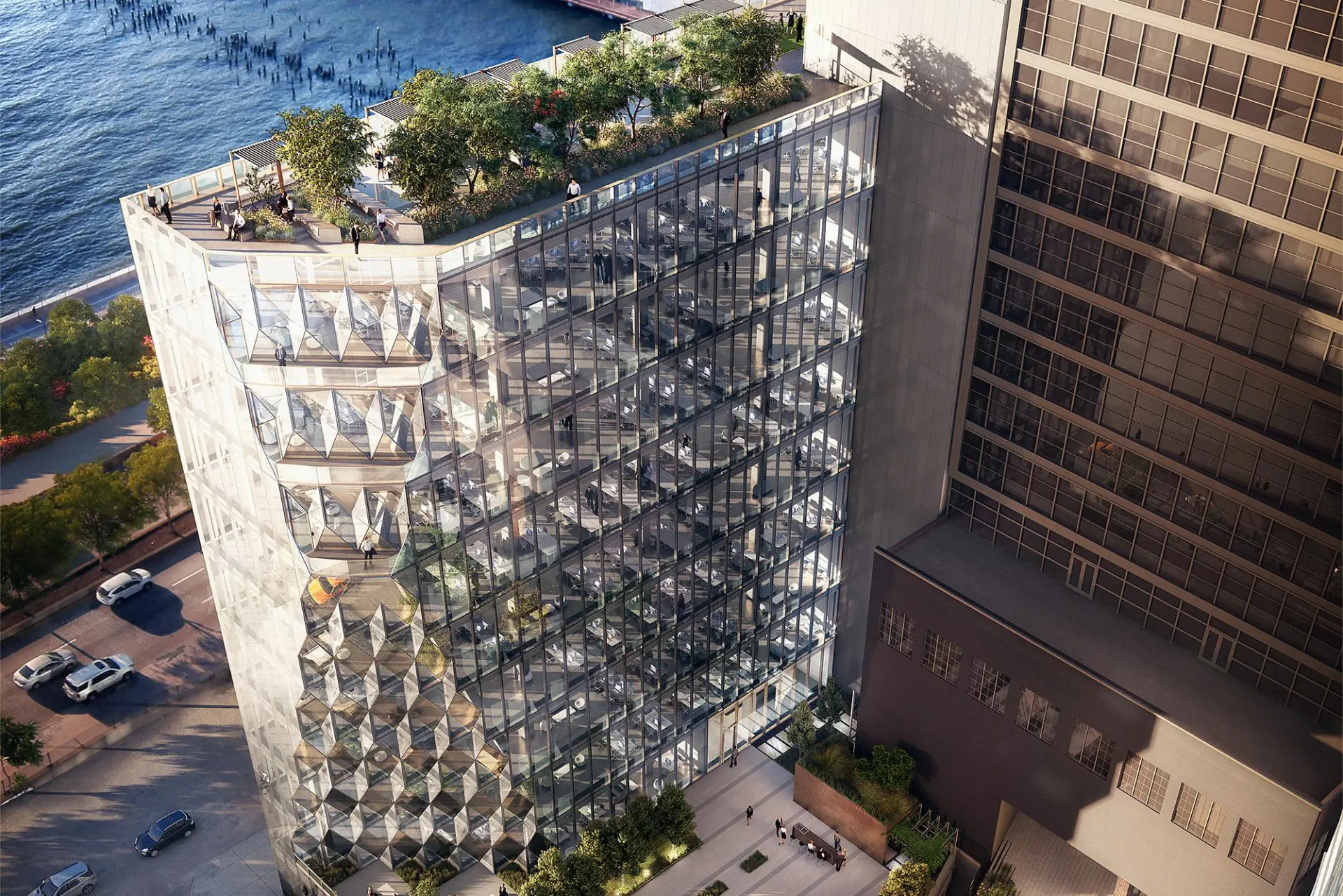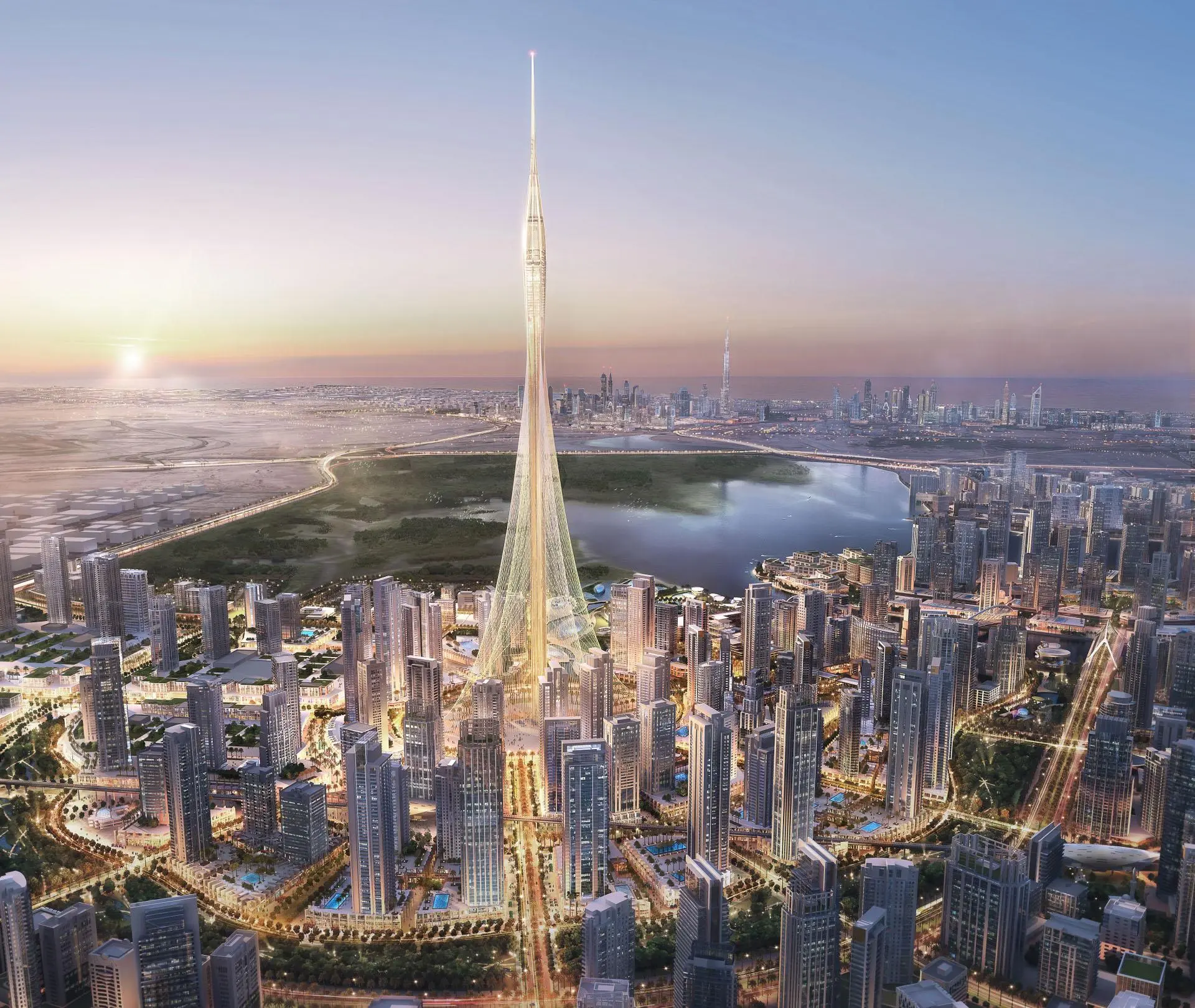
Archive concept rendering of Dubai Creek Tower within Dubai Creek Harbour. The image depicts the original proposal, not a confirmed final design.
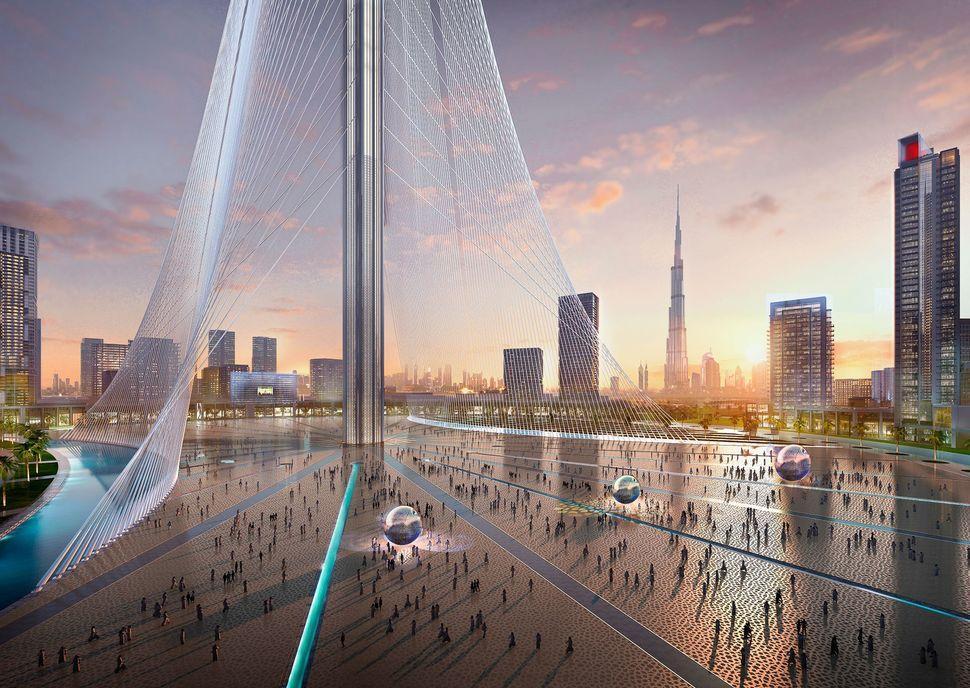
Original concept rendering: the supporting cables frame an expansive public plaza at the tower’s base.
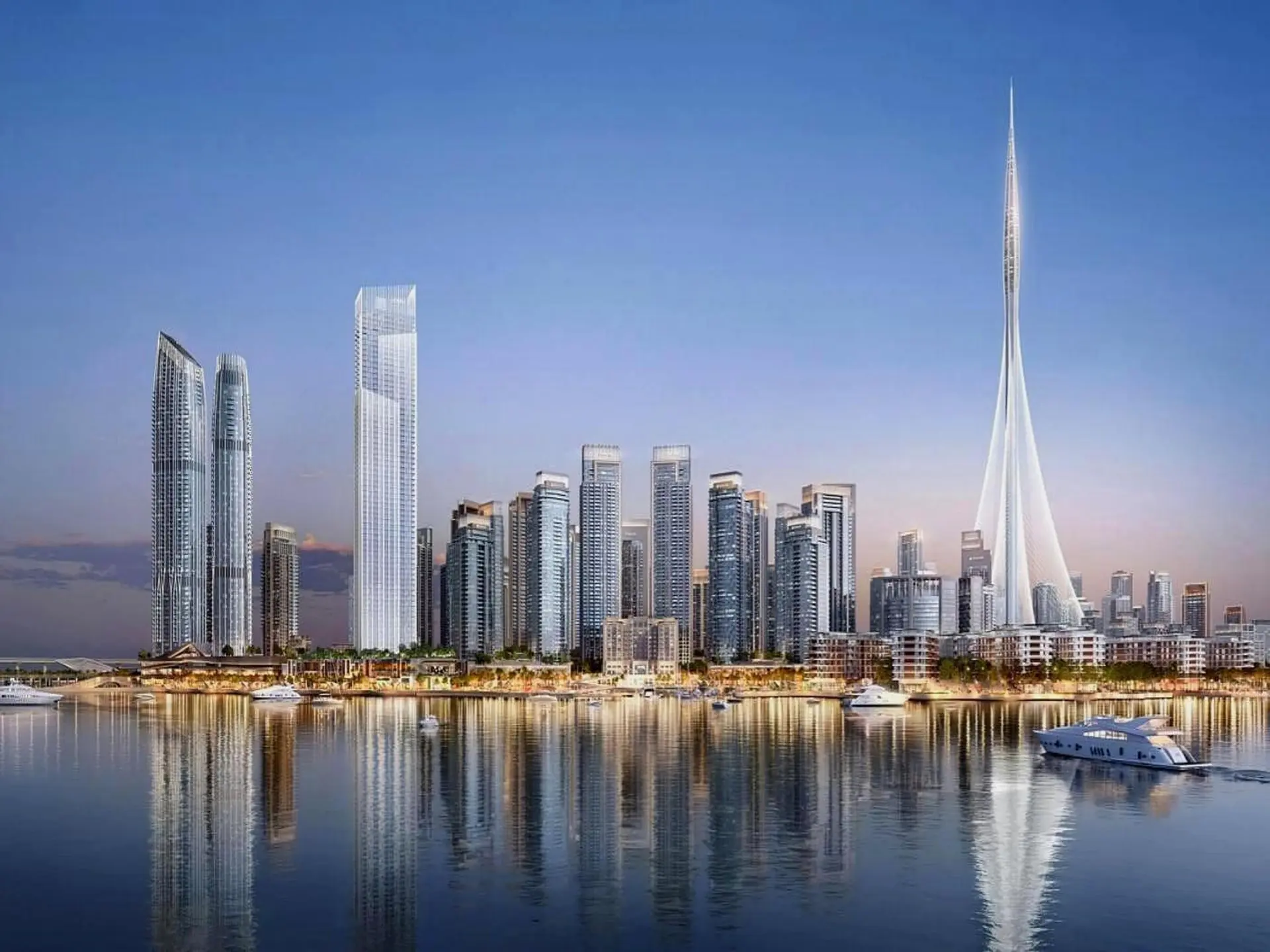
Archive waterfront rendering of Dubai Creek Harbour with the original tower concept beyond its residential skyline.
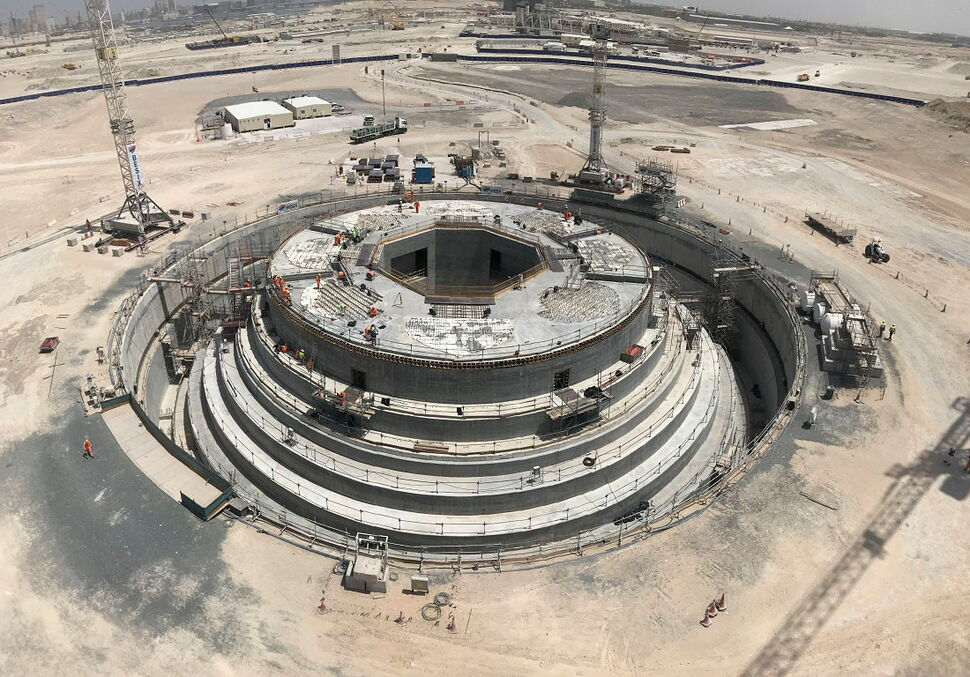
An earlier construction photograph showing foundation works at the Creek Tower site; it does not establish the project’s current construction status.
Dubai Creek Tower: Calatrava’s Architectural Landmark on the Waterfront
WAAR Editorial · 5 min read
At the intersection of architectural ambition, waterfront living and Dubai’s evolving skyline, Dubai Creek Tower represents a vision of urban development shaped by the city’s enduring relationship with water. Its significance lies not simply in the prospect of another extraordinary structure, but in the identity it could give to an entire district.
Dubai has never been a city content with standing still. From its historic creekside trading settlements to its emergence as a global metropolis, architecture has repeatedly expressed its ambitions. Along the evolving waterfront of Dubai Creek Harbour, the proposed landmark opens another chapter — one concerned with contemporary design, its surroundings and the experience of the city itself.
Dubai Creek remains one of the city’s most significant geographical and cultural landmarks. Long before the rise of its modern skyline, it served as a centre of commerce, maritime activity and community life. Today, the wider waterfront is being reinterpreted through residential neighbourhoods, hospitality, public spaces and destination retail.
It is within this landscape that the tower finds its architectural context. Although flower imagery is sometimes used to describe its silhouette, the project is known as Dubai Creek Tower; the original architectural inspiration was a lily rather than a confirmed separate development named Tulip Tower.
ARCHITECTURE: A DIALOGUE BETWEEN NATURE AND HERITAGE
The original proposal by architect and engineer Santiago Calatrava moved beyond the conventional language of vertical glass-and-steel skyscrapers. Drawing on the natural contours of a lily and the elegant verticality of Islamic minarets, it brought organic form into conversation with regional architectural tradition.
Calatrava envisioned a slender central spine, an expressive network of supporting cables and an elongated crown resembling a flower bud. The structure did not conceal its engineering: the cables were integral to its visual identity, making structural necessity part of the architectural composition.
The crown was conceived to contain observation spaces with panoramic perspectives across Dubai’s skyline. Lighting was intended to accentuate the silhouette after dark, allowing the tower to become a luminous point of orientation within the wider waterfront.
These elements belong to the original concept. They explain the architectural thinking that first captured international attention, but should not be mistaken for a confirmed specification of the redesigned project.
BEYOND THE SKYLINE: CREATING A DESTINATION
The ambition behind the Creek landmark was never limited to height or visual impact. Its wider role was to attract residents, tourists and international visitors into Dubai Creek Harbour, giving the district a focal point that could be experienced as well as observed.
The original proposal envisaged observation decks, elevated gardens, hospitality spaces, cafés and public gathering areas. A plaza and surrounding public realm were intended to establish a relationship between the tower and the master-planned neighbourhood around it.
This is where monumental architecture encounters its most demanding test. A landmark can command a distant skyline, yet its success at ground level depends on pedestrian access, shade, landscape and the quality of the spaces people actually inhabit.
For Dubai Creek Harbour, the tower was conceived as the centrepiece of a larger waterfront environment in which promenades, residential communities, retail and leisure could reinforce one another. The enduring value of such a project lies in that relationship, not simply in the object at its centre.
A CHANGING VISION: FROM HEIGHT TO ARCHITECTURAL IDENTITY
The story of the tower has evolved. The original proposal attracted worldwide attention for its ambition to potentially surpass the Burj Khalifa. Subsequent revisions have shifted the discussion towards architectural expression and the experience of the surrounding district.
In January 2026, Emaar founder Mohamed Alabbar confirmed that the design had changed and announced an intention to issue a tender within three months. Reporting from the Dubai International Project Management Forum quoted his emphasis on the aesthetics of the building and its surroundings, rather than altitude alone.
The tender did not proceed on that initial timetable. In November 2026, Khaleej Times reported that Alabbar was withholding a large-tower tender while the regional situation eased; the report connected the remarks to the previously announced Creek Tower tender, while noting that he had not named the tower in those remarks. Cost considerations also formed part of the wider discussion of construction delivery.
As of November 2026, the final architectural design, height, construction programme and completion date remain publicly unconfirmed in the reporting reviewed for this feature. The supplied archive renderings therefore illustrate the original vision, not the appearance of a confirmed future building.
This uncertainty makes the next chapter particularly interesting. A redesigned landmark could represent a more considered approach to monumental architecture, one in which elegance, context, engineering and experience carry greater weight than numerical records.
DUBAI CREEK HARBOUR: THE NEXT WATERFRONT CHAPTER
The tower’s importance extends beyond the structure itself. Dubai Creek Harbour is emerging as a major waterfront destination, bringing together residential development, retail, hospitality, public spaces and connections across a growing district.
Its proximity to Ras Al Khor Wildlife Sanctuary adds a distinctive environmental dimension. The contrast between wetlands and an increasingly sophisticated urban skyline presents an opportunity for architecture to acknowledge a protected natural landscape rather than treating its setting as an empty backdrop.
The district’s future success will depend not simply on iconic buildings, but on the spaces between them: pedestrian connections, waterfront promenades, landscape, public amenities and the everyday experience of residents. Environmental sensitivity will have to be demonstrated through planning and delivery, not assumed from proximity alone.
In this respect, the Creek landmark expresses an aspiration for a neighbourhood with a recognisable identity and a meaningful relationship to Dubai’s geography — a place that is more than a collection of separate buildings.
WAAR PERSPECTIVE
Dubai’s architectural history is often told through scale, innovation and spectacle. Its next chapter may be defined equally by refinement: how buildings respond to climate, landscape, culture and human experience.
Calatrava’s original Creek Tower proposal made a powerful case for architecture in which organic form, cultural symbolism and engineering are inseparable. Whether the final tower retains that lily-inspired language or adopts a different expression remains to be seen. Its position within Dubai Creek Harbour nevertheless gives it the potential to become a defining landmark.
The most memorable architecture does more than occupy space. It creates a sense of place, gives a city a new perspective on itself and enters the collective imagination. Whatever form the Creek’s future landmark ultimately takes, that is the ambition by which it should be judged.